Everyone, have you ever had an experience like this?
Your child won’t wake up, or they say, “I hate this!” about the breakfast you made. Or your spouse forgot a promise… When that happens, a small fire lights up in your heart, right? You snap, saying “Why!,” and end up throwing strong words at them. Then afterwards, you regret it, but the atmosphere remains tense.
Anger is a natural human emotion. But how we handle it is incredibly important. The story of Cain and Abel in Genesis Chapter 4 starts right here. The “small anger” that was born in Cain’s heart. He couldn’t control it, and it eventually led to a major, irreversible sin. The core of this chapter is the beginning of two paths: the lineage of Cain and the lineage of Seth—the
“path that departs from God” and the “path that calls upon God.”
Cain and Abel: The Origin and Manifestation of Sin (Verses 1–5)
“With the help of the LORD I have brought forth a man.”(Verses1)
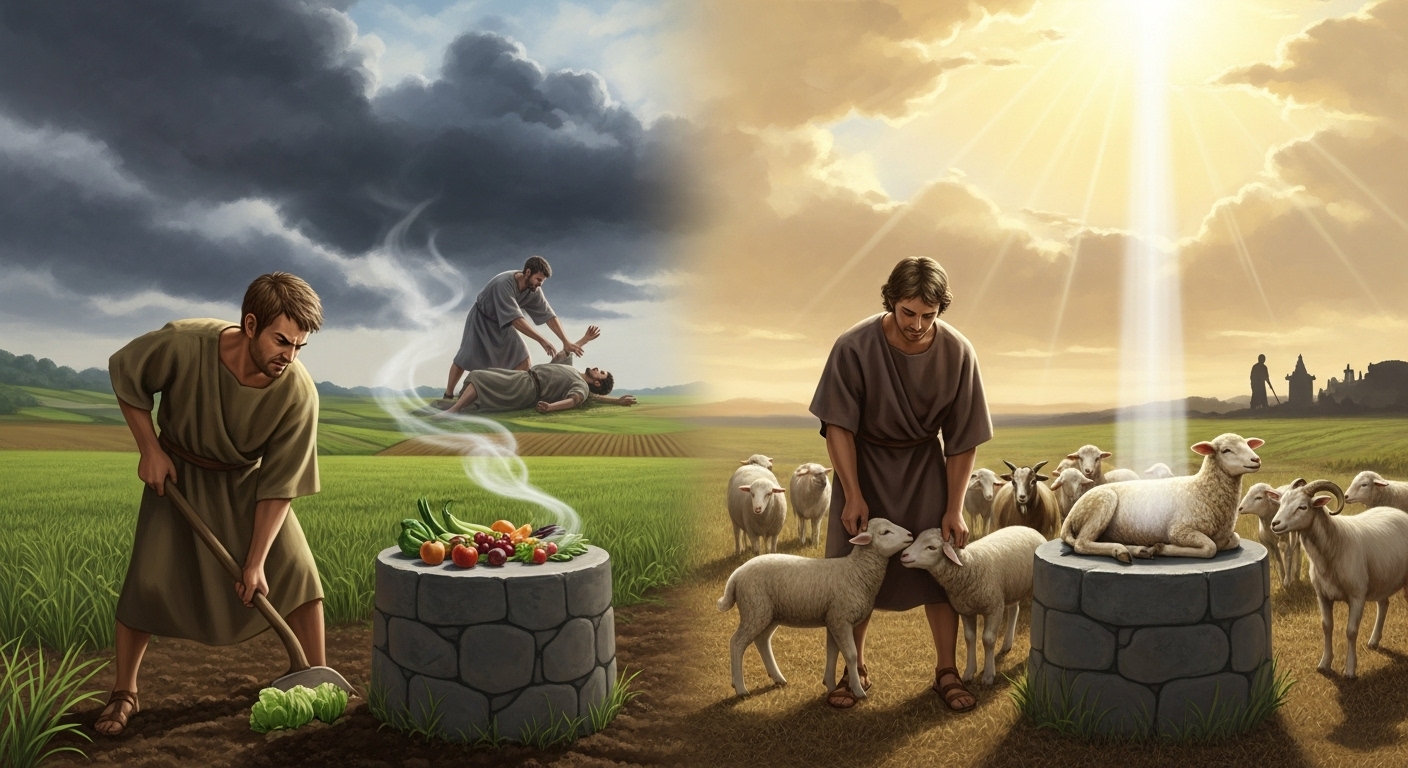
When their first son, Cain, was born, Eve recognized it as God’s work, a result of God’s grace and mercy. Adam and Eve had their first son, Cain (a farmer), and their second son, Abel (a shepherd).
Back then, the diet was vegetarian, based on the produce of the ground. That’s because of Genesis 3:18, where it says, “You will eat the plants of the field.”
The purpose of raising sheep was for getting things like milk, wool, and skins.
Permission to eat meat only came much later, after Noah’s flood. That’s in Genesis 9:3, where God says, “Everything that lives and moves about will be food for you. Just as I gave you the green plants, I now give you everything.”
The Offering
There was a difference in the quality of the offerings:
- Abel brought “fat portions from some of the firstborn of his flock”—a blood sacrifice, and the best, personally.
- Cain merely brought “some of the fruits of the soil” (it’s not described as the “best”).
The issue wasn’t just a difference in their heart’s attitude, but whether or not there was a
blood sacrifice. Abel’s faith is the key. Hebrews 11:4 says,
“By faith Abel…” and Hebrews 12:24 says, “than the blood of Abel.”
The problem is
“the presence or absence of faith.” A worship done out of habit does not please God. God desires us to offer worship that truly rejoices in Him from the heart.
Sin is Crouching at Your Door (Verses 6–8)
When Cain was angry, God spoke to him:
“Sin is crouching at your door; it desires to have you, but you must rule over it.”
Sin doesn’t just attack us from the outside; it lurks deep in our hearts, looking for a chance.
“Comparison,” “jealousy,” and “anger” can take control of us in an instant.
God commanded him to “rule over it.”
However, Cain succumbed to sin and committed the first murder in human history by killing Abel.
God Shows Mercy Even in Judgment (Verses 9–16)
God issued a strict punishment: Cain was declared a
“restless wanderer” on the earth, cursed so that the ground would no longer yield its produce. This was a further punishment, representing the loss of human security and productivity. Yet, God responded to Cain’s complaint and gave him “a mark” to protect him.
This was a sign of God’s mercy, showing that He chose not to bring complete destruction, but still allowed him to live. This fact, that
“there was mercy even for Cain,” points to the Gospel that “there is mercy for us too.”
However, Cain still turned his back on God and went to live in the land of Nod, east of Eden.
The Two Lineages: The Fork in Human Nature (Verses 17–26)
The Lineage of Cain: The Development of Self-Centered Culture
Cain “left the presence of the LORD” and settled in the land of Nod. He built a city. This act of
“leaving the presence of the LORD” symbolizes the beginning of a human-centered ideology: building civilization through one’s own power and wisdom. Cain’s lineage produced Jabal (nomadic herdsmen), Jubal (musicians), and Tubal-Cain (metalworkers). This shows that human technology, culture, and art developed from this lineage that departed from God.
The development of iron-making technology in the Middle East happened in Anatolia (which is modern-day Turkey) by the great ancient Near Eastern empire, the Hittite Kingdom, around 1400 BC.
The history of iron is said to have begun when the Hittite King Anitta got an iron crown and scepter as war spoils after attacking the city of Purushanda, meaning they were getting iron objects from other regions. The fact that Tubal-Cain is described as “who forged all kinds of tools out of bronze and iron” is consistent with the development of metalworking technology in the Near East during the time the Bible was written (around the 15th–13th century BC). The existence of the Hittite Kingdom is one of the archaeological pieces of evidence that supports the historical credibility of the Bible’s account.
Also, the Mari Kingdom in ancient Mesopotamia—which was located in Tell Hariri, modern-day eastern Syria, in the middle Euphrates basin—shows the coexistence of Cain’s lineage (city building) and Seth’s lineage (focused on herding) in a historical context. This is based on the Mari documents excavated from the ancient city of Mari (around the 18th century BC). It shows that in the ancient Near East, urban civilization and nomadic culture were not in opposition but had a mutually complementary relationship.
This discovery serves as archaeological evidence that the biblical account accurately reflects the social conditions of the time.
A notable figure is
Lamech, the sixth generation from Cain. He began polygamy, deviating from God’s established marriage system. Furthermore, his famous
“Song of Revenge” boasts, “If Cain is avenged seven times, then Lamech seventy-seven times.” This illustrates how human sin and violence escalate endlessly when relying on one’s own power.
The Lineage of Seth: Faith and Return to God (Verses 25–26)
After Abel’s death, Adam and Eve were given a new son, “Seth”.
Eve said, ‘With God’s help, I have borne a son to replace Abel, since Cain killed him.’ And positioned Seth as the beginning of the lineage of faith to replace Abel. Seth also had a son, whom he named Enosh.
The Bible records:
“At that time people began to call on the name of the Lord.”
This indicates that the path of faith, founded on a relationship with God, began with this lineage.
This lineage of faith is recorded as the line of blessed people who acknowledged human weakness and chose the path of dependence on God.
Genesis Chapter 4 :Concluding Invitation
The end of Genesis Chapter 4 presents us with two paths. One is the
“path that moves away from God as civilization advances.” The other is the
“path of worship and faith, calling on the name of the Lord.”
Which path will we walk?
Will you allow your heart to be captured by convenience and success, walking a path that forgets God? Or will you choose the other path—to call upon God daily, saying “Lord,” and live by His mercy?
Jesus Christ is the ultimate fulfillment of this “lineage of faith.
Even though we were trapped in sin, He opened the way to new life for us through the cross and the resurrection.
” Let us also walk today as those who “call on the name of the Lord.”
Only the heart that calls upon God is what gives us life.


コメント (手動承認)