Worship Message No. 28, March 15: Revelation Chapter 11
Introduction
What if a person continued to speak what was right, and as a result, was hated by people all over the world and finally killed?
Furthermore, what if people celebrated that death?
It is an unbelievable event, but such a scene is depicted in the Bible.
That is Revelation Chapter 11.
In this chapter, “two witnesses” who speak God’s message appear. They call on people to repent, but the world rejects their voices and eventually takes their lives.
However, the story does not end there.
Three and a half days later, an unimaginable event occurs.
God brings them back to life.
In this chapter, hope that is not lost even in a chaotic world is depicted.
First, let us confirm the flow up to this point
Revelation is not a book that suddenly begins at Chapter 11. Up to Chapter 10, a tempestuous development has continued.
Seven seals were opened (Chapters 6–8), and war, famine, plague, and cataclysms were depicted one after another. Seven trumpets were blown (Chapters 8–9), and judgments on the earth, sea, rivers, and celestial bodies followed. It is a development so intense that even reading it feels suffocating.
And in Chapter 10, there was a “pause” in the judgment. John ate a “little scroll” and was told to “prophesy again.”
Chapter 11 is the “content of that prophecy.” It depicts the appearance of those who speak the truth in the midst of a world under judgment.
1. Measuring the Temple: God Knows Your “Inside” (v. 1–2)
At the beginning of Chapter 11, John is given a reed like a measuring rod and told:
“Go and measure the temple of God and the altar, with its worshipers.” (Revelation 11:1, NIV)
The act of “measuring” consistently carries the meaning of “God protects” and “God owns” throughout the Bible. In Ezekiel chapters 40–48 as well, measuring the temple has been depicted as a symbol of God’s protection and restoration.
In other words, in this scene, God is saying: “No matter how much the world is in chaos, I have a firm grasp of My people. I will not overlook even one of you.”
Many of you likely remember the scenes immediately after the Great East Japan Earthquake on March 11, 2011, when members of the Self-Defense Forces, firefighters, and police continued their search through the rubble, calling out each person’s name one by one. There was the conviction that “this person was surely here” and the will to “never give up until they are found.” Many Japanese people were deeply moved by that sight.
God’s command to “measure and count” is very close to that exact sentiment. Your name is written in God’s notebook.
On the other hand, verse 2 says:
“But exclude the outer court; do not measure it, because it has been given to the Gentiles. They will trample on the holy city for 42 months.”
Forty-two months—three and a half years. This is a symbolic number representing a “period of hardship” that has been used throughout the Old Testament. It carries the meaning of being half of the perfect number “7”—in other words, a period that is “incomplete, yet one that will surely come to an end.”
There is an end to suffering. This is the promise of the Bible.
Second Theme: Beyond What Seemed to be the “End” (v. 3–14)
The heart of Chapter 11 is the story of the “two witnesses.” This scene is particularly striking within Revelation and is rich in symbolic meaning.
“And I will appoint my two witnesses, and they will prophesy for 1,260 days, clothed in sackcloth.” (Revelation 11:3, NIV)
1,260 days is three and a half years, the same as the 42 months mentioned earlier. The number “two” comes from the requirement in Old Testament law that “a matter must be established by the testimony of two or three witnesses” (cf. Deuteronomy 19:15) for a testimony to be valid. God is declaring, “This is an official and certain testimony.”
The Bible describes these two as “the two olive trees and the two lampstands, and they stand before the Lord of the earth” (v. 4, NIV). This language recalls the symbolism in the book of Zechariah in the Old Testament, signifying a work supported by the Spirit of God. A lampstand is a device that gives off light, existing to illuminate dark places. In other words, the two witnesses are depicted as those who shine the light of God’s truth in a dark and chaotic era.
In verses 5 and 6, they are given extraordinary power. They consume enemies with fire, stop the rain, turn water into blood, and strike the earth with plagues. For those who reject God’s word, power is shown that symbolizes severe judgment. This description reminds us of the work of the prophets Elijah and Moses. Elijah called down fire from heaven, and Moses demonstrated God’s power through plagues. For this reason, many Bible scholars believe the two witnesses symbolize these prophets.
However, it is difficult to conclude that these two refer to specific individuals.
Rather, a widely held interpretation is that they symbolize the entirety of those who speak God’s word. In other words, it is possible that the image of believers who continue to speak God’s truth throughout history is expressed here through the two witnesses.
Yet, their work was not all smooth sailing.
In verse 7, the situation changes abruptly.
“Now when they have finished their testimony, the beast that comes up from the Abyss will attack them, and overpower and kill them.” (Revelation 11:7, NIV)
People reject their words, oppose them, and eventually take their lives. Revelation depicts this event in very intense terms. They are killed, their bodies are exposed in the street (v. 8–9), and people are so glad that they celebrate and send each other gifts (v. 10).
Though this was written 2,000 years ago, it is staggeringly realistic. Looking back at history, examples of those who sincerely spoke God’s word being persecuted and erased from society are too many to count. This was true for the “Hidden Christians” (Kakure Kirishitan) in Japan, and it is the exact situation facing Christians in underground churches in modern-day China and North Korea.
“Even if you do what is right, you will be crushed.”
This is something that happens in real society as well. The person who lost their job after whistleblowing, the person who became isolated after speaking out against injustice, the business owner who was laughed at as “old-fashioned” for valuing people over profits. Such stories overflow in the world, even if they don’t make the news.
However, the story does not end there.
From verse 11, the scene changes completely.
“But after the three and a half days the breath of life from God entered them, and they stood on their feet… Then they heard a loud voice from heaven saying to them, ‘Come up here.’ And they went up to heaven in a cloud…” (Revelation 11:11–12, NIV)
Death was not the end. After the short period of three and a half days, God’s breath entered them, and they stood up. Those who saw this were struck with great terror.
This has the exact same structure as the resurrection of Jesus Christ: killed, buried, but then God breathes the breath of life into them. This is the pattern that runs through the entire Bible.
It was in 1985 that Steve Jobs was ousted from Apple, the company he founded. People thought he was “finished.” But he built up his strength at NeXT and Pixar, returned to Apple, and sparked a revolution with the iMac, iPod, and iPhone. What looked like the “end” was actually the beginning of the next chapter.
The witnesses of God are the same. In human eyes, it looked like they had “lost” or been “erased.” This event has been understood not merely as a story of a miracle, but as the hope of faith. The voice that speaks the truth, even if it appears to be silenced temporarily, will never be completely extinguished. Within God’s plan, that work continues in a new form.
When we apply this to our lives, this story overlaps with the experiences of many.
There are times when you are not understood even when you try to live sincerely. There are times when you become isolated as a result of speaking what you believe is right.
Nevertheless, the Bible tells us that God is watching that journey.
The story of the two witnesses has been received as an encouragement to those who continue to hold onto faith even in painful situations.
Even in dark times, there are people who light a lamp.
Even if it is a small light, it illuminates the surroundings.
The two witnesses in Revelation 11 are depicted as existence symbolizing such light.
This story quietly continues to convey the hope that the voice speaking God’s truth will never be completely silenced in a confused world.
Furthermore, in verse 13, after the resurrection of the witnesses, a great earthquake occurs, and the survivors “were terrified and gave glory to the God of heaven.” Even in the midst of judgment, there is an invitation to repentance. God is the One who continues to speak to humanity until the very last moment.
Third Theme: History Has an Ending, and There Is Justice at That End (v. 15–19)
At last, in verse 15, the seventh trumpet sounds. This scene is an extremely important turning point in the overall flow of Revelation.
The previous trumpets heralded disasters occurring in the world—descriptions of natural chaos, social unrest, and the suffering brought about by human sin.
However, the seventh trumpet is somewhat different.
A loud voice echoes in heaven:
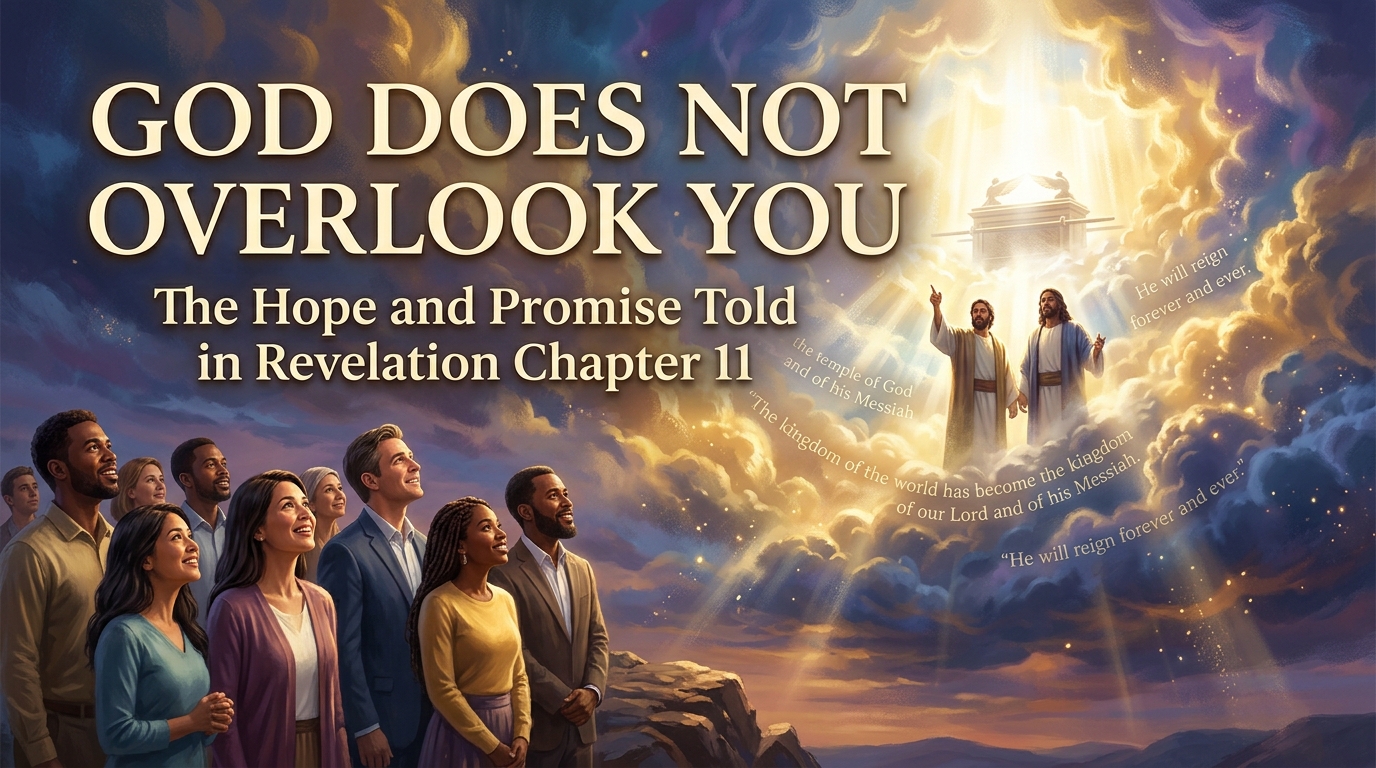
“The kingdom of the world has become the kingdom of our Lord and of his Messiah, and he will reign for ever and ever.” (Revelation 11:15, NIV)
This is a “pre-declaration” of the conclusion of the entire Book of Revelation. Although the judgments will continue, God declares the victorious conclusion here in advance. It is a message that the end point of history has already been determined. In other words, the seventh trumpet is not just one event among many, but a proclamation showing where the direction of history is headed.
The “Conclusion” of History Told in Advance
When reading the Bible, we sometimes find something mysterious:
the conclusion is told before the story has even finished.
A similar technique is used in films.
There are works where a “future scene” is shown briefly at the beginning, and then the story proceeds.
The seventh trumpet in Revelation serves a similar role.
The events of the world still continue.
Many more symbolic events are depicted in the latter half of Revelation.
Nevertheless, it is already declared at this moment:
the history of the world will ultimately be placed under the reign of God.
This perspective provides great peace of mind to those who have faith.
・Why a “Trumpet”?
In the world of the Bible, the trumpet was an instrument with special meaning.
Trumpets were blown in three main situations:
- To announce the arrival of a king.
- To gather the people.
- To herald the beginning of a battle.
The trumpets in Revelation contain all of these meanings:
God appearing as King,
God’s people being gathered, and
God’s justice appearing in the world.
The seventh trumpet sounds as the signal announcing that completion.
・ Heavenly Worship
After the trumpet sounds, worship begins in heaven.
In verses 16–18, the twenty-four elders worship God and say:
“We give thanks to you, Lord God Almighty, the One who is and who was, because you have taken your great power and have begun to reign… The time has come for judging the dead, and for rewarding your servants the prophets and your people who revere your name, both great and small…” (Revelation 11:17–18, NIV)
This contains three promises:
- Justice will surely be realized. Those who have done evil will be judged.
- Rewards will surely be given. Those who have lived sincerely for God will surely be rewarded.
- The nameless are also remembered. The phrase “both great and small” means that all people, regardless of social status or fame, are recorded equally before God.
Since the collapse of the bubble economy, many corporate scandals have come to light in Japan—window-dressing settlements, data falsification, and power harassment. We have seen in the news how people who thought they “handled things well” were cornered one after another 10 or 20 years later.
On the other hand, the news also tells us that the testimonies of those who refused to participate in injustice and left their companies, those who blew the whistle and became isolated, and those who continued to speak the truth as a minority—those voices later became a deterrent for society. History has an end. At that end, there is a Judge named God. This is not a threat, but the greatest hope for those who have suffered unreasonably.
In verse 19, the temple of God in heaven is opened, and the ark of His covenant appears. It is a declaration that “God’s promise has not been broken.” Flashings of lightning, an earthquake, and a great hailstorm—Chapter 11 closes with the overwhelming manifestation of God’s presence.
Applying It to Life
If we compare this scene to life, it is like the final chapter of a long story.
In the middle, various things happen—
there are successes and failures, and moments that feel unreasonable.
However, at the end of the story, everything is tied together in a way that has meaning.
The Bible tells us that human history is likewise within God’s story.
The events we are seeing now may still be on a page in the middle.
Nevertheless, in the final chapter, the completion of God’s reign is depicted.
The scene showing that hope is the declaration of the seventh trumpet.
● A Message of Hope
Revelation was a book written for believers who were in the midst of persecution and hardship.
People at that time felt they were a minority and held a weak position in society.
To such people, Revelation speaks:
the end of history does not end by chance.
The world is moving toward completion within the reign of God.
The seventh trumpet is a symbolic sound pointing to that certain future.
Like the sound of a trumpet heard from afar, the arrival of the Kingdom of God has already been declared.
And that resonance continues to give hope to many people today, across the ages.
・From Today’s Revelation Chapter 11, to You
I have shared three things with you:
God counts you properly. Even in a world of chaos, your name is written in God’s notebook.
Living as God’s witness comes with a price. However, death is not the final word. God has an invitation for you: “Come up here.”
History has an ending, and there is justice at that end. Even the nameless and the small are properly remembered.
If you feel that “no one sees me” or “living sincerely brings no reward,” please read these words from Revelation 11 aloud once more:
“Go and measure the temple of God and the altar, with its worshipers.” (Revelation 11:1, NIV)
You are being counted. You have not been overlooked.
This is the promise that John risked his life to record 2,000 years ago, which has been passed down to this day. Amen.

コメント (手動承認)