Good morning, everyone.
This morning, from Genesis 10 and 11, I will speak on the theme, “Not people who make a name for themselves, but people who are called.”
This Bible passage, at first glance, consists of two completely different parts.
One part is a genealogy where the names of 70 nations continue endlessly.
To be honest, it is a passage that could make one sleepy when reading.
The other part is the dramatic story of the Tower of Babel.
Human arrogance and God’s judgment. The confusion of language and the scattering of humanity.
Why did the Bible record these two side-by-side?
In fact, these two are telling the same event from different angles.
Chapter 10 is history seen “from the outside”—the expansion of nations.
Chapter 11 is history seen “from the inside”—the reason why they expanded.
And between these two chapters, one person stands.
A man named Nimrod, “the first powerful man on earth.” He is the bridge connecting Chapters 10 and 11.
This morning, we want to look at how genealogy and story, history and theology, and judgment and grace are interwoven to form one beautiful tapestry.
Please open your Bible to [Genesis 10].
Genesis 10:The Spreading of Humanity and the Hand of God
After the great flood, God blessed Noah and his family.
“Be fruitful and increase in number and fill the earth.”
Chapter 10 describes, exactly as those words, how many nations spread out from Noah’s three sons, Shem, Ham, and Japheth.
That is, it is the “Table of Nations ( תוֹלְדוֹת Toledot)” which records how humanity spread throughout the world after the great flood.
If you are unfamiliar with ancient place names, it may look like a somewhat tedious list of Katakana (Japanese phonetic script), but this is a chapter with great theological and geographical significance.
Seventy nations appear here.
This shows that God blessed the diversity of humanity.
Race, language, and culture—each is a part of God’s creation.
A person named “Nimrod” is recorded among the descendants of Ham.
He was the first warrior/mighty man on earth, in Hebrew “a mighty one ( גִּבֹּר Gibbor),” and he left his name as a person who built a kingdom.
Nimrod is the peak of human greatness, and at the same time, its limit.
His achievement connects to the human arrogance spoken of in Chapter 11.
However, what the Bible wants to say is, “It is God, not man, who moves history.”
No matter how great a king is, his name is forgotten when time passes.
Wealth and power are not eternal.
All people prosper in the time and opportunity given by God, and then quietly retire.
It is God Himself who is truly working behind the scenes of history.
The Conclusion of Genesis 10 (verse 32)
“These are the clans of Noah’s sons, according to their lines of descent, within their nations. From these the nations spread out over the earth after the flood.”
This conclusion shows the fact that all humanity originally had one root, one family.
This is in complete agreement with the following words preached by Paul at the Areopagus.
“From one man he made all the nations, that they should inhabit the whole earth; and he marked out their appointed times in history and the boundaries of their lands. God did this so that they would seek him and perhaps reach out for him and find him, though he is not far from any one of us.” (Acts 17:26-27)
Genesis 11:Self-Centered Unity and God’s Judgment
Please open your Bible to Genesis 11.
Then, when we move into Chapter 11, that blessing becomes twisted.
“Now the whole world had one language and a common speech.”
The people were united.
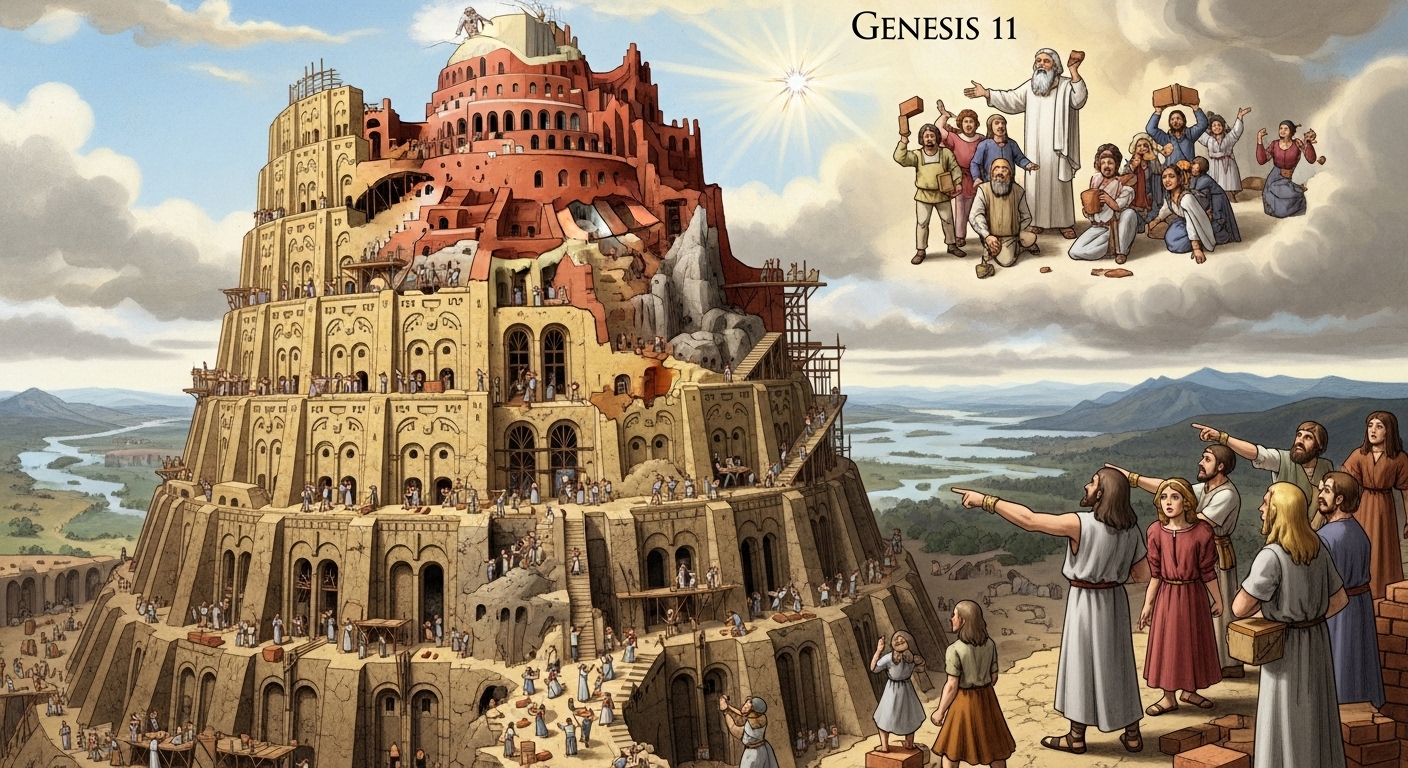
They settled in a plain in Shinar and said, “Come, let us build ourselves a city, with a tower that reaches to the heavens, so that we may make a name for ourselves.”
And, fearing to be scattered, they sought to secure their own safety by “uniting as one.”
God commanded them, “Fill the earth,” yet they said, “We do not want to be scattered.”
In that place, there was a unity centered not on God, but on humanity.
It was a unity not for the glory of God’s name, but to “make a name for themselves.”
This heart is the same temptation the serpent spoke to Eve in Genesis 3: “You will be like God.”
What was born there was the Tower of Babel.
The Tower of Babel is a symbol of human arrogance.
Humanity tried to approach God by building a tower that reached the heavens.
However, the Bible says: “But the LORD came down to see the city and the tower the people were building.”
No matter how high the human tower was, in God’s eyes, it was “low enough for him to have to come down to see.”
Man cannot reach God.
Heaven and earth are connected only when God comes down.
This “God who comes down” is precisely what points to Jesus Christ, who later became man.
God confused their language and scattered them over the face of the whole earth.
This may seem like punishment at first glance, but it is actually the restoration of the blessing.
When people confine themselves to their own plans, God “scatters” us to restore humanity to its original mission: “Fill the earth.”
In our lives, too, there are events that do not go as planned. There are times when the tower we have built up is torn down. That is not God punishing us, but teaching us, “You must not stay there.” God pushes us once more toward His purpose, which is to “fill the earth.”
At the Tower of Babel, people tried to “make a name for themselves.”
But in the latter half of Chapter 11, God chooses one man from the descendants of Shem: Abram (later Abraham).
God said to him, “I will make your name great,” (Genesis 12:2).
In contrast to Babel, where humans tried to make a name for themselves, God promised, “I will make your name great.”
Abram’s father, Terah, was an idol worshiper: “Joshua said to all the people, “This is what the LORD, the God of Israel, says: ‘Long ago your ancestors, including Terah the father of Abraham and Nahor, lived beyond the Euphrates River and worshiped other gods.” (Joshua 24:2).
Abram was not chosen because he possessed a “special faith,” like Noah.
It was solely by God’s mercy and sovereign choice.
The path of Babel, where man seeks to make a name for himself, and the path of Abraham, where God chooses and gives a name, diverge here.
The name Babel became “Confusion (בָּבֶל),” while Abraham’s name remains forever as “Father of Faith.”
The only difference is whether one lives for oneself or responds to God’s calling.
Today’s world also seems like Babel.
The voice of humanity striving to unite the world through human power echoes.
Through technology, economy, and language, we seem to be “one.”
However, if God is not at the center of that, it will once again become the Tower of Babel.
The church is not a place to build a tower with human strength.
It is a place where people scattered in the name of God are gathered once more “in the name of the Lord.”
The languages confused at Babel were unified by the Holy Spirit on the Day of Pentecost in Acts 2.
When the Holy Spirit came down on the Day of Pentecost, people from various nations heard one Gospel. The languages divided at Babel were unified by the Holy Spirit.
Unity centered on God is the true unity.
Today, too, God sometimes breaks down the Tower of Babel in our lives.
That is to call us out.
It is so that you become “a person called by God” rather than “a person who makes a name for himself.”
The Lord remembers your name.
Summary: The Cross, Not the Tower
There is the Tower of Babel, and there is another tower.
At Babel, humans tried to build a tower that reached the heavens. “Come, let us make a name for ourselves.”
However, God “had to come down” to see that tower.
Man’s best efforts did not reach God.
However, there is another tower. It is the cross set up on the hill of Golgotha.
There, God “came down” to us.
At Babel, humans tried to ascend to heaven.
At Calvary, God came down to earth.
At Babel, humans tried to make a name for themselves.
At Calvary, Christ emptied himself of his name and became obedient even to death on a cross.
At Babel, human effort created confusion and division.
At Calvary, Christ’s sacrifice brought reconciliation and unity.
The Apostle Paul said.
“Who, being in very nature God, did not consider equality with God something to be used to his own advantage; rather, he made himself nothing by taking the very nature of a servant, being made in human likeness. And being found in appearance as a man, he humbled himself by becoming obedient to death— even death on a cross!” (Philippians 2:6-8)
This is God’s final answer to Babel.
We do not need to try to reach God, because God has reached us.
[Invitation]
My beloved friends, and those who have joined us online.
This morning, two towers stand in this place.
One is the Tower of Babel.
It symbolizes your effort, your merit, and your achievements.
You think, “If I try harder,” “If I become a better person,” “If I become more religious”—then I will reach God.
The other is the Cross.
It symbolizes the finished work of Christ. You do not need to reach God.
God has reached you. All you need to do is receive it.
Which tower will you stand on?
If you have not yet believed in Christ:
This morning, there is an invitation.
Stop building your own tower, and come under the cross of Christ. There, you will find your salvation.
If you are a Christian:
But you are still trying to approach God through your own effort. This morning, return once again to the cross.
Everything is already finished.
In John 19:30, Christ said, Tetelestai (τετέλεσται)—”It is finished” (NIV).
And to everyone:
The cross of Christ has broken the curse of Babel.
Now, all people can approach God in Christ.
Regardless of race, nationality, language, or past.
“His purpose was to create in himself one new humanity out of the two, thus making peace, and in one body to reconcile both of them to God through the cross, by which he put to death their hostility.” (Ephesians 2:15–16, NIV).
Will you respond to God’s invitation this morning?
If you have not yet experienced God’s grace, I wholeheartedly encourage you to respond to God’s electing love today and become a part of this community of salvation.
Amen.


コメント (手動承認)