[Worship Introduction: The Story of Emperor Augustus and God]
Dear brothers and sisters, Luke begins the story of Jesus Christ’s birth with the name of the ruler of the world at that time, Emperor Augustus. He was the man at the pinnacle of the Roman Empire. With a single word from him, people throughout the empire were forced to move.
However, what Luke truly wants to convey is not the story of this man of power. While the powerful were moving on the main stage of history, behind the scenes, God’s story of salvation was quietly beginning.
Today, focusing on this contrast, I want us to learn what kind of person God is.
Let us read the Bible. Please open your ears and open your hearts.
[Reading of Luke 2:1-20]
- Part 1: The Emperor’s Ambition and God’s Providence (Behind the Scenes of History) (Verses 1-7)
- Part 2: The Announcement to the Shepherds and “Do Not Be Afraid” (Verses 8-20)
- The Announcement to the Shepherds: Why Was It Shepherds? (Verse 8)
- The Angel’s Proclamation: From Fear to Joy
- The Sign: The Paradox of the Manger
- The Response of Faith: “Let’s Go”
- Mary’s Faith: Pondering the Word of God (Rhema)
- “Treasuring all these things and pondering them in her heart.”
- The Basic Meaning of “ῥῆμα (Rhema)”
- 【May it be to me according to your word】
- ・Testimony: Personal Experience of Rhema (1 Corinthians 6:19-20)
- [Invitation to Us: Jesus in the “Vacant Space” of Your Heart]
- [Conclusion: Immanuel (God Is With Us)]
Part 1: The Emperor’s Ambition and God’s Providence (Behind the Scenes of History) (Verses 1-7)
The Emperor’s Ambition and God’s Providence (Behind the Scenes of History)
The Christmas story begins with a decree from the world ruler of that time, Emperor Augustus.
“Augustus” means “the exalted one.” As the first emperor of the Roman Empire, he did not doubt for a moment that “I rule the world” and “I am the one moving history.” By his single command, people under the rule of the Roman Empire were forced to move.
Joseph and Mary were among them, a poor couple living in the town of Nazareth.
From Nazareth to Bethlehem is about 150 kilometers. Even today, it is a difficult journey, but 2000 years ago, for Mary who was in her final month of pregnancy, it was truly a life-threatening journey for both mother and child.
However, the Emperor did not know. He did not know that his arrogant command was actually being used to fulfill a prophecy from 700 years earlier.
The prophet Micah said:”But you, Bethlehem Ephrathah… out of you will come for me one who will be ruler over Israel” (Micah 5:2, NIV).
Normally, their child living in Nazareth should have been born in Nazareth. But God used even the power of the Emperor as a tool to lead Joseph and Mary to Bethlehem, the land of promise. At the very moment Augustus thought, “I am the king of the world,” the true King was about to be born in a place far beyond human plans. This is the providence of God.
Three Meanings of “There Was No Guest Room Available for Them”
Joseph and Mary arrived in Bethlehem by God’s plan, but what awaited them there was a harsh reality. Verse 7 says briefly, yet heavily: “there was no guest room available for them” (NIV).
These words “no room” contain three deep meanings.
① Physically “No Place”
The town was overflowing with people for the census. Joseph must have knocked on doors desperately. He must have pleaded, “My wife is about to give birth.” However, the only responses were cold rejections: “We’re full” or “There is no room.”
② Socially “No Place”
If they had been wealthy or powerful, someone might have given up a room. However, they were an unknown, poor couple. Society paid no attention to them, and no one offered a seat. They were treated as invisible beings and driven away to a stable.
③ Spiritually “No Place”
And this was a prophetic event symbolizing the life of Jesus Christ.
“He came to that which was his own, but his own did not receive him” (John 1:11, NIV).
He had no room in the inn at His birth, had “no place to lay his head” (Luke 9:58, NIV) throughout His life, and finally was crucified outside the city walls (Luke 23:33). This world did not prepare a place for its Creator.
God’s Paradox: Why a Manger?
However, here lies God’s amazing paradox.
Where did God cause His Son to be born?
It was not a palace, but a stable.
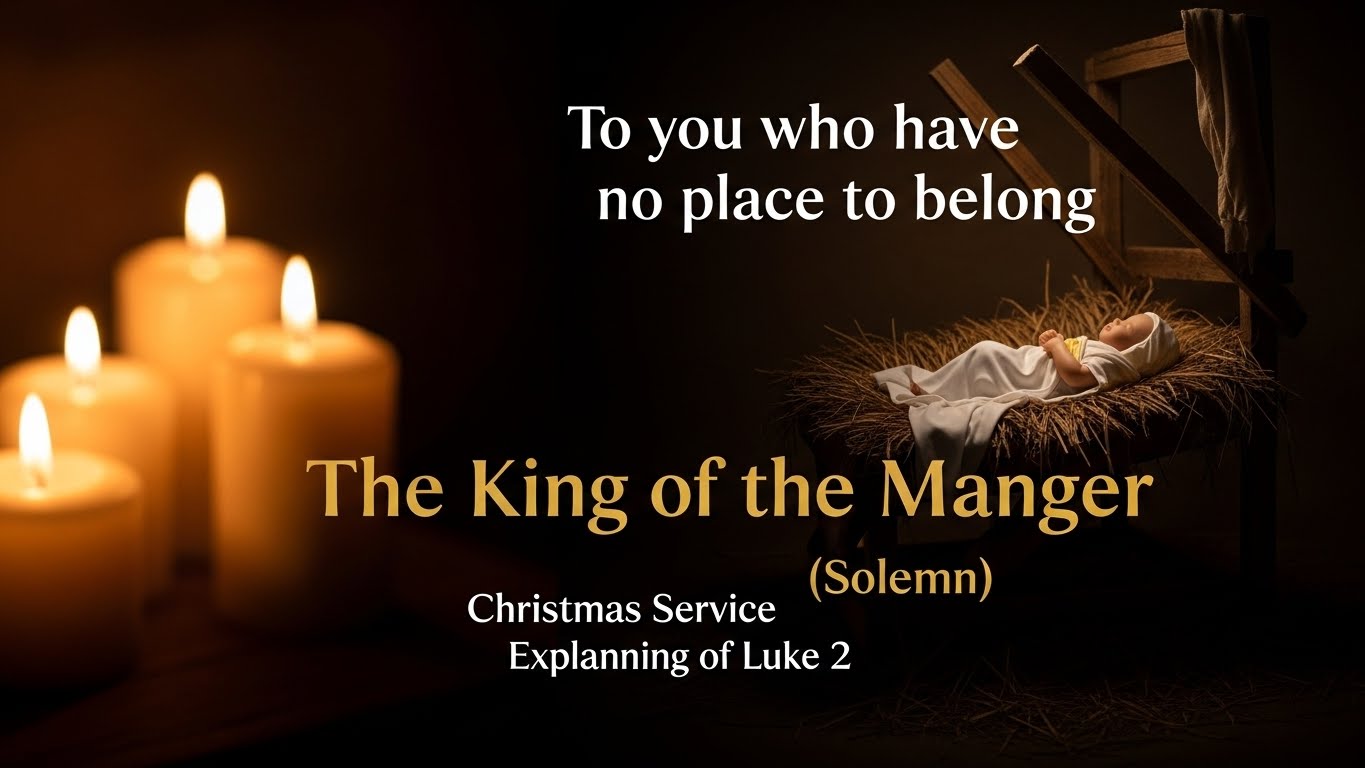
Also, not in a golden cradle, but in a manger (a feeding trough).
Furthermore, not in royal robes, but wrapped in humble cloths.
This is not a coincidence. It is an intentional message from God.
Jesus Christ knows the pain of those who are excluded and marginalized. Because He Himself was born into a situation where there was thoroughly “no place.”
・To Us Today
This message speaks two things to us living now.
First, to you who feel “I have no place.”
Is there anyone who feels they have no place at work, at home, or in society?
If you are in loneliness due to financial reasons, age, illness, or an invisible sense of alienation, please remember: Jesus, the Son of God, knows your pain. God’s salvation reaches not the palace, but precisely those who are at their lowest and feel they have no place.
Second, to us who are “too busy.”
This morning, our own hearts are also being questioned: “Is there a place for Jesus in your life?”
Are our hearts “full” like the “inn” of that time? Occupied with work, hobbies, SNS, money, anxiety about the future… are we refusing Jesus when He comes, saying, “I’m sorry, we’re full”?
However, Jesus does not give up.
“Here I am! I stand at the door and knock” (Revelation 3:20, NIV).
Even if a luxurious guest room is not vacant, Jesus is happy to enter even a place like a dirty stable.
The one who showed His love through the helplessness of a manger rather than the power of Augustus.
Today, let us welcome Him into the “vacant space” of our hearts.
Part 2: The Announcement to the Shepherds and “Do Not Be Afraid” (Verses 8-20)
The Announcement to the Shepherds: Why Was It Shepherds? (Verse 8)
God’s plan of salvation always begins in a way that defies our expectations.
To whom did the angel first appear? Was it to the powerful in the palace of Jerusalem? Was it to the priests in the temple? No, it was to nameless shepherds who were living out in the fields nearby, keeping watch over their flocks at night.
At that time, shepherds were positioned at the bottom of society.
Their work was irregular and easily made them “unclean,” making it impossible for them to strictly observe religious “purification” or the Sabbath. Also, in the Jewish legal texts of the time (Talmud), their testimony was not accepted in court, and they were even looked down upon as “sinners who might deal in stolen goods.”
In short, they were the most socially untrusted people whose words no one would believe.
However, God dared to choose them.
The greatest news in human history, the first gospel proclamation—
“Today in the town of David a Savior has been born to you”—was directed toward these who were made the least.
The Angel’s Proclamation: From Fear to Joy
When the angel appeared with light, verse 9 says the shepherds were “terrified” (NIV). This is a natural reaction.
They may have felt alienated from society and far from God’s blessing on a daily basis.
However, the angel said:
“Do not be afraid. I bring you good news that will cause great joy for all the people” (Verse 10, NIV).
In this short declaration, all of the Gospel (the Good News) is packed.
“Do not be afraid”: God does not want us to live in fear. God’s light came to remove fear.
“Great joy”: The Gospel is not a notice of duty or judgment, but of overwhelming “joy.”
“For all the people”: This is not a secret for only the privileged class. It is open to everyone, including people like the shepherds.
Verse 11: “Today in the town of David a Savior has been born to you; he is the Messiah, the Lord” (NIV).
“Today… for you”: This is not a story of the distant future. Now, and personally “for you,” the Savior (Christ) has come.
Following this declaration, a great company of the heavenly host joined in, and praise erupted.
“Glory to God in the highest heaven, and on earth peace to those on whom his favor rests” (Verse 14, NIV).
This was the encounter of heaven and earth, the moment when glory to God (vertical) and peace to man (horizontal) became one.
The Sign: The Paradox of the Manger
The angel gives the shepherds a strange “sign.”
“This will be a sign to you: You will find a baby wrapped in cloths and lying in a manger” (Verse 12, NIV).
If it were the birth of a king, a palace or a luxurious bed should be the “sign.” However, God made the “manger,” a feeding trough for livestock, the sign of the Savior.
This is God’s paradox.
God sought to save us not through power but through weakness, not through majesty but through humility.
The Response of Faith: “Let’s Go”
How did the shepherds react? They didn’t say, “No way” or “Let’s go in the morning.” They immediately decided, “Let’s go to Bethlehem,” and went “hurriedly.”
Verses 15-16 show the three steps of their faith:
① They believed (“which the Lord has told us about”)
② They acted (“hurried off”)
③ They found (“found”)
In verses 17-18, they spread the word concerning what had been told them. The shepherds, who were the least trusted in society, became the world’s first “evangelists.”
This is the fulfillment of the Word: “God chose the foolish things of the world to shame the wise” (1 Corinthians 1:27, NIV).
Mary’s Faith: Pondering the Word of God (Rhema)
Mary’s Meditation and the Shepherds’ Praise (Verse 19)
On the other hand, Mother Mary shows a contrasting reaction.
“But Mary treasured up all these things and pondered them in her heart” (NIV).
While the shepherds were running around in excitement, Mary was quietly meditating.
Mary knew:
Gabriel’s visit (Luke 1:26-38)
Elizabeth’s prophecy (Luke 1:42-45)
Simeon’s prophecy (Luke 2:34-35) “A sword will pierce your own soul too.”
She must have felt anxiety along with joy regarding the destiny of this child.
“Treasuring all these things and pondering them in her heart.”
I will explain this from the original text. As background knowledge, for the word “word” in the New Testament, the Greek words “λόγος (Logos)” and “ῥῆμα (Rhema)” are used.
Logos = Objective, universal truth (the overall picture of God’s plan).
Rhema = Subjective, individual application (a specific message to the believer).
Luke uses “Rhema” and “Logos” differently depending on the scene.
Scenes using “Rhema”: Direct intervention by God (e.g., the Annunciation, the shepherds’ report).
Scenes using “Logos”: Teaching or preaching (e.g., 8:11 “The seed is the word [Logos] of God”, 11:28).
The Basic Meaning of “ῥῆμα (Rhema)”
A Greek word referring to a “spoken word,” “event,” or “declaration,” which implies not just information but a “powerful word of God” or a “promise to be fulfilled.”
It corresponds to the Hebrew “Davar” (דָּבָר) in the Old Testament and emphasizes God’s interventional message (e.g., Psalm 33:6 “By the word [Rhema/Davar] of the Lord the heavens were made”).
・Luke’s Intent
By repeatedly using “Rhema,” Luke emphasizes:
Mary’s faith in continuing to believe God’s promise (1:38).
Her posture of pondering the Annunciation and the fact that the promise became reality (2:19). By drawing the night in Bethlehem contrastively, he emphasizes that “the entire event of the Incarnation was according to God’s plan.”
【May it be to me according to your word】
“What was the ‘Rhema’ that Mary received?”
Mary accepted the angel’s “Rhema (God’s word).”
Mary treasured the “Rhema (the word about the event)” told by the shepherds in her heart.
In this way, Mary first accepted God’s Rhema by faith, and thereafter continued to “ponder” (symballousa συμβάλλουσα) the process of that Rhema being realized.
This is an intentional literary connection by Luke, depicting Mary’s journey of faith.
・Testimony: Personal Experience of Rhema (1 Corinthians 6:19-20)

“Actually, I am also one who was given and received a ‘Rhema’ (God’s word). I still remember it vividly. It was during my devotion (Bible reading) on April 4, 2004. It was right after I returned from a Holy Land trip to Israel and Jordan in March of that year.
When I was reading 1 Corinthians chapter 6, that Word seemed to rise up from the Bible and jump out at me.”
“Do you not know that your bodies are temples of the Holy Spirit, who is in you, whom you have received from God? You are not your own; you were bought at a price. Therefore honor God with your bodies.” (1 Corinthians 6:19-20, NIV)
After this experience, I re-entered seminary and was led to the path of a pastor and missionary, reaching the present day.
Now, back to the main topic.
The shepherds returned to their original fields.
The situation might not have changed. They might have returned to the same work, the same poverty.
However, they returned “glorifying and praising God” (Verse 20, NIV). Their hearts were no longer the same as before. They had seen the Savior.
We also return to our respective places of life from this Christmas service.
But like the shepherds, let us be sent to our respective places carrying the joy and praise of Immanuel, “God is with us.”
[Invitation to Us: Jesus in the “Vacant Space” of Your Heart]
Dear friends, today’s story is speaking to each one of us.
There Is a Place for You Too
If you feel “there is no place for me,” please remember. Jesus Christ Himself had no place in this world. However, it was precisely for that reason, for someone like you, that Christ came.
Why did God lay His Son in a manger? This was an intentional choice. God could have prepared a golden cradle. He could have had angels build a palace. But God chose a manger. As found in Isaiah 53:1-3, the Messiah came from the beginning as a Suffering Servant.
“He had no beauty or majesty to attract us to him, nothing in his appearance that we should desire him. He was despised and rejected by mankind…” (Isaiah 53:2-3, NIV)
Paul explains this theologically in Philippians 2:6-8:
“Who, being in very nature God, did not consider equality with God something to be used to his own advantage; rather, he made himself nothing by taking the very nature of a servant, being made in human likeness. And being found in appearance as a man, he humbled himself by becoming obedient to death—even death on a cross!” (NIV)
John 1:14 is one of the most important verses in the Bible, declaring the core of the Christian faith, the “Incarnation”:
“The Word became flesh and made his dwelling among us. We have seen his glory, the glory of the one and only Son, who came from the Father, full of grace and truth.” (NIV)
This is the ultimate expression of God’s love.
God is not one who stays far away and issues orders, but one who descended into our midst, shared our joys and sufferings, and ultimately gave His life to save us.
The “grace” here is Charis (χάρις) in Greek. Its meaning is “unmerited favor toward those who do not deserve it,” “God’s free gift.” We received the gift of Christ even though we had no qualifications.
【The Origin and Blessing of the Name Kurobe Charis Agape Church】
Now, our church’s name is “Kurobe Charis Agape Church.” Here, I will testify to the meaning we put into the name “Kurobe Charis Agape Church.”
We chose two Greek words that represent the essence of God: “Charis (Grace)” and “Agape (Unconditional Love).”
As we saw earlier, Charis (χάρις) means “God’s one-sided grace toward those who do not deserve to receive it.”
Agape (ἀγάπη) means “unconditional love” or “willful, sacrificial love,” representing the nature of God’s own love.
“Charis Agape Church”—in this name,
we express our identity as “those saved by God’s grace (Charis)” and
our mission as “a flock that responds to God’s love (Agape) and loves one another.”
Rooted in God’s grace (Charis) and love (Agape), this church was built by the Holy Spirit to witness the Gospel in the land of Kurobe.
This concludes the origin of the name Kurobe Charis Agape Church.
Now, back to the main topic.
If Jesus had been born in a palace, there would have been gatekeepers and guards; not just anyone could have entered. But if it’s a stable, anyone can enter. Even shepherds, even the poor, even sinners. Jesus was open to everyone from the beginning. Jesus is not a distant God. Jesus is Immanuel (עִמָּנוּאֵל – God is with us, Isaiah 7:14; εμμανουηλ, Matthew 1:23). It means “God is with us.”
If you think, “I am too small, too weak, God could never use me,” remember the shepherds. God is the one who chooses and uses those whom society ignores.
The Courage to Come to the Manger
The shepherds said, “Let’s go.” They temporarily abandoned their work, took a risk, and headed for Bethlehem.
We also need a decision to go to Jesus Christ. It might mean changing the priorities of our lives. It might mean letting go of our pride or fear.
A manger is not a palace. It is not luxurious or impressive. However, the Savior is there. We need the courage to seek truth rather than appearance or status.
And the manger points to one more thing: the Cross. Both the manger and the Cross were made of wood. Jesus was laid in a manger, and Jesus was also laid on the Cross. The manger is a place for animal feed, but Jesus became the “Bread of Life” (John 6:35, 48).
Matthew 1:21 says:”You are to give him the name Jesus, because he will save his people from their sins” (NIV). The name Jesus means “The Lord is salvation.” The purpose for which He came was not just to be born or to teach, but to die. And to rise again. Christmas is the prologue to Easter.
This morning, please open the door. Revelation 3:20 says:
“Here I am! I stand at the door and knock. If anyone hears my voice and opens the door, I will come in and eat with that person, and they with me” (NIV).
In the inn of your heart, please make a room for Jesus.
Becoming a Bearer of Joy
The shepherds told people what they had seen. They could not help but share the joy they had experienced.
The joy of Christmas is not something to keep to oneself. It is something to be shared. Is there anyone around you who feels “there is no place for me”? Is there anyone carrying loneliness, being marginalized, or losing hope?
We can be those who carry the joyful news to them that “a Savior has been born for you.” Not just by words, but by actions. By accepting them. By being with them.
[Conclusion: Immanuel (God Is With Us)]
Dear everyone, and those participating via YouTube,
the world today is still occupied by those with power and wealth on the main stage. However, God’s eyes are fixed on the little ones.
2000 years ago, God chose to be born in a stable. He chose to tell the shepherds first. Today, God is the same. God is with the small, the weak, and those with no place.
Hebrews 4:14-16 says: “Therefore, since we have a great high priest who has ascended into heaven, Jesus the Son of God, let us hold firmly to the faith we profess. For we do not have a high priest who is unable to empathize with our weaknesses, but we have one who has been tempted in every way, just as we are—yet he did not sin. Let us then approach God’s throne of grace with confidence, so that we may receive mercy and find grace to help us in our time of need.”
Jesus is not a distant God. Jesus is Immanuel (God is with us).
Isaiah 7:14 עמנואל Hebrew
Matthew 1:23 εμμανουηλ Greek
This Christmas, will you respond to God’s invitation? Like the shepherds who said, “Let’s go to Bethlehem,” why not go to Jesus Christ? And won’t you share the joy you experience yourself with other people?
“Do not be afraid. I bring you good news that will cause great joy for all the people. Today in the town of David a Savior has been born to you; he is the Messiah, the Lord.”
Let us engrave these words in our hearts once more. This is news for you.
・Blessing
Finally, I offer a prayer of blessing:
Numbers 6:24-26:
“6:24 The Lord bless you and keep you;
6:25 the Lord make his face shine on you and be gracious to you;
6:26 the Lord turn his face toward you and give you peace.”
Amen.

コメント (手動承認)