【SERMON INTRODUCTION】
Good morning, everyone.
This morning, we want to study Genesis Chapters 14 through 15 together.
These two chapters record very important events in the journey of Abraham’s faith.
Chapter 14 records battle and victory, and Chapter 15 records one of the most important declarations in the entire Bible.
That is the statement: “He believed the Lord, and he credited it to him as righteousness.”
This statement was later quoted by the Apostle Paul in his letters to the Romans and the Galatians to explain the core teaching of the gospel: justification by faith.
So, what is God speaking to us through these two chapters?
We will look at the message in the following three parts:
Part 1 (Chapter 14) – Victory and Worship
Part 2 (Chapter 15:1-6) – Justification by Faith
Part 3 (Chapter 15:7-21) – Establishment of the Covenant
Let’s look at it together.
Now, please open to Old Testament Chapter 14.
Genesis Chapter 14: “The Battle of Faith and the Blessing of Melchizedek”
• Lot’s Crisis and Abraham’s Action (Verses 1-16)
First is Chapter 14. This describes the international situation at the time.
The coalition of four kings from Mesopotamia attacked the five kings around the Dead Sea. And in that battle, Abraham’s nephew, Lot, was taken captive along with the residents of Sodom.
Everyone, there is something I want you to recall here. In Chapter 13, Abraham and Lot separated, right?
Lot chose the region of Sodom by looking with his own eyes. It was a well-watered, rich land.
But it was a sinful town.
Lot sought secular prosperity and chose a dangerous place. And as a result, he was caught up in this war.
But what did Abraham do?
Look at Verse 14. “When Abram heard that his relative had been taken captive, he led out the 318 trained men born in his household and went in pursuit.” (NIV for 14:14)
Abraham did not hesitate. He acted immediately.
He led 318 trained servants and went to rescue Lot.
Here is an important lesson we should learn.
First, a believer has a responsibility to family.
Lot was the nephew who caused Abraham trouble. He was the one who made a selfish choice and left.
But Abraham did not abandon him. He risked danger to go and rescue him.
Perhaps we also have family members who are distant from faith.
Perhaps we have people who cause us trouble.
Nevertheless, we have a responsibility to pray for them and help them when necessary.
Second, victory is given to those who walk with God.
Look at Verse 15. Abram’s tactic was a guerrilla attack under the cover of night.
He pursued the forces of Kedorlaomer all the way to Hobah, north of Damascus, and won a victory.
318 men defeated the coalition of four kings. This was humanly impossible.
The historian Josephus records that King Kedorlaomer’s men were drunk on the spoils of war.
But because God was with Abraham, he was able to win the victory.
• The Encounter with Melchizedek, who is King and Priest (Verses 17-20) Now, after this victory, a very interesting event occurs. Let’s look from Verse 18.
“Then Melchizedek king of Salem brought out bread and wine. He was the priest of God Most High.” (NIV for 14:18)
Suddenly, a person named Melchizedek (מַלְכִּי־צֶדֶק) appears.
He was the king of Salem, which is later Jerusalem, and at the same time, the “priest of God Most High.”
This person is a very mysterious figure in the Bible. His genealogy of parents, and the beginning or end of his life are not recorded.
And in Hebrews Chapter 7, this Melchizedek is explained to be a type, a foreshadowing of our Lord Jesus Christ.
Melchizedek blessed Abraham. And Abraham offered a tenth of the spoils of war to him.
What does this mean?
It means that Abraham recognized a greater spiritual authority in Melchizedek than himself.
And he expressed his gratitude to God in the form of an offering.
This offering was long before the Law of Moses was given.
In other words, it was not commanded by the Law, but was an expression of voluntary gratitude and worship.
Shouldn’t our offerings be the same?
Not as an obligation, but offered with joy as thanks for God’s grace. Such a heart is important.
• Refusal of the Offer from the King of Sodom (Verses 21-24)Now, from Verse 21, there is another important scene.
The King of Sodom said, “Give me the people and keep the goods for yourself.”
He said Abraham could freely take the spoils of war. This was a chance for Abraham to gain great wealth.
But what did Abraham answer?
Verses 22 to 23: “14:22 But Abram said to the king of Sodom, “With raised hand I have sworn an oath to the Lord, God Most High, Creator of heaven and earth, 14:23 that I will accept nothing belonging to you, not even a thread or the strap of a sandal, so that you will never be able to say, ‘I made Abram rich.’”” (NIV for 14:22-23)
Why? Abraham says, “It is so that you will not say, ‘I made Abram rich.'”
Everyone, this is a very important attitude for a believer.
Abraham refused to accept wealth from a secular king. Because,
he knew that God alone was the one who blessed him.
We also sometimes face the temptation to seek success and wealth by the world’s values and methods.
But Abraham teaches us:
To put the relationship with God first. Not to forget that God alone is the source of true blessing.
Even if a great opportunity is before us, if it is not God’s will, we should not take it.
That kind of decision of faith is what is required of us.
Part 2: The Principle of Salvation: Justification by Faith (Genesis 15:1-6)
• Do Not Be Afraid
Now, we enter Chapter 15.
Verse 1: “15:1 After this, the word of the Lord came to Abram in a vision: “Do not be afraid, Abram. I am your shield, your very great reward.”” (NIV for 15:1)
After the battle, God spoke to Abraham. “Do not be afraid.”
Why did God say, “Do not be afraid”?
Perhaps fear was in Abraham’s heart. He had opposed the four kings. Perhaps they might come for revenge. He might have had such anxiety.
But God said, “I am your shield.”
Everyone, God is our shield. God will protect us. Therefore, there is no need to be afraid.
And He promised, “your very great reward.”
Abraham refused the reward from the King of Sodom. But the reward from God was far greater than that.
• The Reality of Being Childless However, Abraham held one big worry in his heart.
Verses 2 to 3: “15:2 But Abram said, “Sovereign Lord, what can you give me since I remain childless and the one who will inherit my estate is Eliezer of Damascus?” 15:3 And Abram said, “You have given me no children; so a servant in my household will be my heir.”” (NIV for 15:2-3)
God had promised a blessing. But he had no children. If things remained this way, Eliezer, a servant of his house, would become his heir.
Abraham was struggling between God’s promise and his own reality.
Everyone, don’t we sometimes have similar experiences?
God has promised. But reality doesn’t change. Only time passes.
At this time, 10 years had already passed since Abraham came to Canaan at the age of 75.
But he still hadn’t been given a child.
His wife Sarai was also elderly. Humanly speaking, the situation was already impossible.
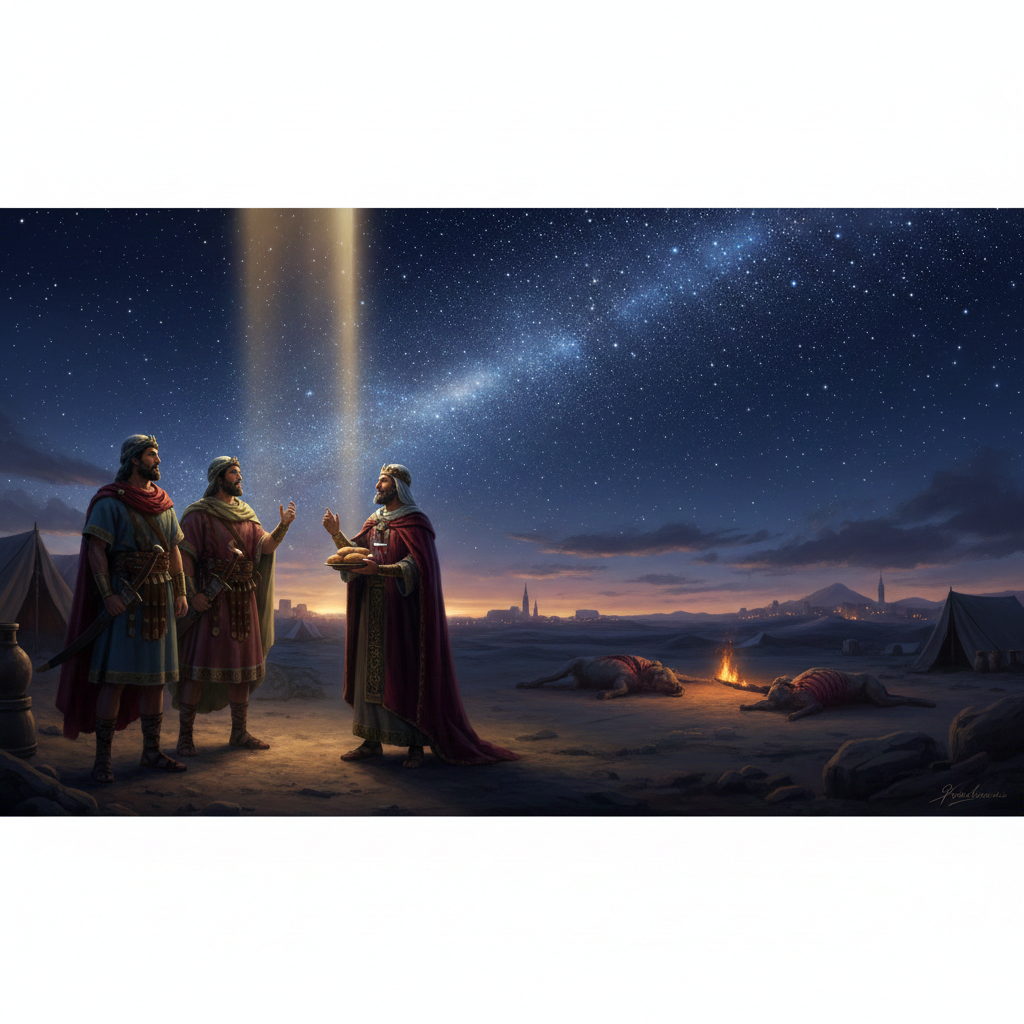
• Count the Stars But what did God say? Verses 4 to 5: “15:4 Then the word of the Lord came to him: “This man will not be your heir, but a son who is your own flesh and blood will be your heir.” 15:5 He took him outside and said, “Look up at the sky and count the stars—if indeed you can count them.”” (NIV for 15:4-5)
And He said this: “So shall your offspring be.”
Imagine Abraham looking up at the night sky.
Countless stars are shining. An uncountable number of stars.
God said, “Your descendants will be as numerous as these stars.”
It is humanly impossible. But nothing is impossible for God.
And in Verse 6, one of the most important declarations in the entire Bible is recorded:
“Abram believed the Lord, and he credited it to him as righteousness.”” (NIV for 15:6)
• Justification by Faith This passage: “He believed the Lord, and he credited it to him as righteousness.”
This is the core of the gospel.
What did Abraham do? He did not perform any special good works.
Nor did he keep the Law. Because the Law had not yet been given.
Abraham simply believed God. He simply believed God’s promise.
It was a humanly impossible promise. But Abraham believed that God could do it.
And God credited that faith as righteousness.
This is the doctrine of “Justification by Faith.
” Everyone, this is the gospel. This is the foundation of our salvation.
We cannot accumulate enough righteous deeds to stand before God.
However, simply by believing God’s promise, which is the work of Jesus Christ on the cross, we are credited as “righteous” and are saved.
In Romans Chapter 4, Paul quotes this example of Abraham and says:
“What does Scripture say? “Abraham believed God, and it was credited to him as righteousness.”” (NIV for Romans 4:3)
And in Galatians 3:6, it is also quoted: “Galatians 3:6 Consider Abraham: “He believed God, and it was credited to him as righteousness.”” (NIV for Galatians 3:6)
This shows that the way of salvation is the same for people in the Old Testament era and for us in the New Testament era.
The principle of salvation has not changed at all since Abraham’s time.
By faith alone. By Christ alone. By grace alone.
Part 3: Establishment of the Covenant (Genesis 15:7-21)
• Abraham Seeks Assurance
Now, God continued to speak.
Verse 7: “He also said to him, “I am the Lord, who brought you out of Ur of the Chaldeans to give you this land to take possession of it.”” (NIV for 15:7)
In response to this, Abraham asked.
Verse 8: “But Abram said, “Sovereign Lord, how can I know that I will gain possession of it?”” (NIV for 15:8)
Is this a question of unbelief?
No, it is not. Abraham believes. But he is seeking deeper assurance.
We, too, sometimes ask God, “Is it really true? Are you sure?”
That is not a bad thing. God understands our weakness.
And God gave Abraham a sure sign.
• The Covenant Ceremony Verses 9 to 11, God commanded Abraham to bring some animals. And He told him to cut them in half.
This was a covenant ceremony in the ancient Near East.
Normally, when making a covenant, the two parties of the covenant would cut animals in half and pass between the pieces. It meant, “If I break this covenant, may I become like this animal.”
Abraham cut the animals. And he waited.
Verse 12: “As the sun was setting, Abram fell into a deep sleep, and a thick and dreadful darkness came upon him.” (NIV for 15:12)
And God spoke a prophecy.
Verses 13 to 16, Abraham’s descendants would suffer as slaves in Egypt for 400 years. But in the fourth generation, they would return to this land.
Why doesn’t He give the promised land immediately? Verse 16: “In the fourth generation your descendants will come back here, for the sin of the Amorites has not yet reached its full measure.”” (NIV for 15:16)
God is patient. He is waiting for the iniquity of the Amorites (the various Canaanite peoples’ widespread idolatry and rituals to their gods (Baal, Molek, Asherah, etc.), which can be seen in Leviticus 18) to reach the point where it deserves judgment.
God’s timing is perfect.
• God Alone Passes Between the Pieces of the Covenant And in Verse 17, the decisive moment comes.
“When the sun had set and darkness had fallen, a smoking firepot with a blazing torch appeared and passed between the pieces.” (NIV for 15:17)
The smoking firepot and the blazing torch. This represents the presence of God.
And what I want you to notice is that God alone passed between the cut animals.
Abraham did not pass through. God alone passed through.
What does this mean?
In a normal covenant, both parties bear the obligations of the contract.
However, in this covenant, God alone bears the obligation.
It is an unconditional covenant. This is called a “Unilateral Covenant” in the Bible.
This is a unilateral covenant of grace.
Regardless of whether Abraham keeps his promise, God will surely fulfill His promise. That is the kind of covenant it is.
Everyone, this is the gospel. This is the basis of our relationship with God and us.
Whether we can continue to love God. Whether we can continue to be faithful.
Regardless of that, God will keep His promises. God is faithful.
Of course, we should also obey God. We should live a holy life.
But our salvation does not depend on our deeds. It is by the unilateral grace of God.
Verse 18: “On that day the Lord made a covenant with Abram and said,” (NIV for 15:18)
God made a covenant. He made a sure promise.
【Summary of Chapters 14 and 15】 Conclusion and Application
My beloved brothers and sisters.
This morning, we learned many things from Genesis Chapters 14 and 15.
First, there is victory for those who walk with God.
Abraham won against a great army with 318 men.
It was humanly impossible. But because God was with him, he was able to win the victory.
We also face battles in life. We face trials.
But there is no need to be afraid. God is our shield. God is with us.
Second, prioritize spiritual matters.
Abraham refused the wealth from the King of Sodom.
Because he knew that God alone was the source of true blessing.
We, too, should live according to God’s values, not the world’s values.
Third, and most important, justification by faith.
Abraham simply believed God. That was credited as righteousness.
We, too, are credited as righteous before God by the faith that believes in Jesus Christ alone.
Not by our own deeds. Not by our own efforts.
But simply by the faith that believes in the atonement of Christ on the cross.
Fourth, God’s promise is sure.
God made a unilateral covenant of grace. God alone passed between the pieces of the covenant.
Our salvation does not depend on our faithfulness, but on God’s faithfulness.
God will surely accomplish what He has promised.
Therefore, we can have hope.
Even if the promise does not seem to be fulfilled now.
Even if the situation does not seem to change now.
The promise will surely be fulfilled in God’s time and in God’s way.
Finally, waiting for God’s timing.
Abram came to Canaan at the age of 75. God promised descendants.
And Isaac was born 25 years later, when Abram was 100 years old.
He waited for a long period of a quarter of a century.
But God’s promise was fulfilled.
It is written in Ecclesiastes 3:11:
“He has made everything beautiful in its time.” (NIV for Ecclesiastes 3:11)
God’s timing is the best timing. It is never too early, nor too late.
We are also required to wait with patience.
No matter how many years it takes, God’s promise will surely be fulfilled. And when that time comes, we will know:
Ah, this was God’s best timing.
【Invitation】
My beloved everyone, and those who joined online.
This morning, if you have not yet believed in Jesus Christ.
Today is your day of salvation.
You are not saved by deeds.
Simply by believing, God will credit you as righteous.
If you already believe. Today,
let us recall the certainty of God’s promise.
Your salvation is certain. Because it depends on God’s faithfulness.
And if there is a promise that you are waiting for in your life.
Let us wait with patience. God’s timing is the best timing.
Ecclesiastes 3:11 teaches: “He has made everything beautiful in its time.” (NIV for Ecclesiastes 3:11)
It is never too early, nor too late. God’s timing is perfect.
Abram waited for 25 years. But when that time came, everything was beautiful.
Let us pray.
(Prayer)
Heavenly Father God.
We thank you that we were able to open your word this morning.
We thank you for teaching us about righteousness by faith through Abraham.
We can never be justified before you by our own deeds.
But by the faith that believes in Jesus Christ, you have credited us as righteous.
We sincerely thank you for this grace.
Thank you also for teaching us that your promise is sure.
You are faithful. You are the one who surely fulfills your promises.
There may be things we are waiting for in our lives.
But we believe that you will surely do what is best, in your time and in your way.
We thank you that the Holy Spirit is walking with us and guiding us.
Please give us patience. Please strengthen our faith.
And may we be able to live depending on you alone.
We pray this in the name of the Lord Jesus Christ.
Amen.

コメント (手動承認)