
[Sermon Introduction]
This morning, I have wonderful news for you all.
It is that God uses people who fail.
It is not only perfect people who are used by God.
Abraham, who is called the Father of Faith, actually made a huge mistake.
He was afraid and told a lie. There were times when his faith wavered.
But God did not abandon him.
Despite his imperfection—or perhaps, sometimes even through it—
God advanced His wonderful plan.
Today, perhaps some of you might be thinking, “I keep making mistakes,”
or “I am not the kind of person God can use.”
But today’s passage gives hope to people like us.
God knows all your weaknesses and all your failures.
Despite this, He loves you and desires to use you.
The content today will be discussed under these three aspects of faith:
• The Faith of Calling — The “Departure” in Obedience to God’s Word (Chapter 12:1–9)
• The Faith of Trial — Returning to Grace even after Failure (Chapter 12:10–20)
• The Faith of Choosing — Choosing God’s Promise over what is Visible (Chapter 13)
Now, let us look together at Abram’s journey.
It is also a mirror of our own journey of faith.
Now, please open your Bibles to the Old Testament, Chapter 12.
Genesis Chapter 12: Calling and Response by Faith
God’s Calling and Promise (Verses 1–3)
Everyone, look at the words God speaks to Abram here.
He says, “Go from your country, your people and your father’s household to the land I will show you.” (NIV)
This is not a simple story about moving house.
God commanded Abram to leave three things:
His country, his people/relatives, and his father’s household.
In other words, He is telling him to leave everything he has relied on, everything he is accustomed to, and everything that provides security.
And what I want you to notice is the expression, “to the land I will show you.”
He is not telling him the specific location.
In other words, God is saying, “Depart first. I will tell you the destination later.”
This demands complete trust.
But God did not just say, “Go.” He gave him a wonderful promise.
If you count them, there are seven blessings:
• Make you into a great nation, 2. I will bless you, 3. I will make your name great,
• and you will be a blessing (or “blessing’s foundation”), 5. I will bless those who bless you, 6. and whoever curses you I will curse, and 7. and all peoples on earth will be blessed through you.
What you should remember here is that God’s calling always has two aspects:
One is sacrifice, and the other is promise.
God asks us to let go of something, but it is always for a greater blessing.
Departure and Worship by Faith (Verses 4–9)
Now, look at verse 4. It says, “Abram went, as the Lord had told him.”
How old do you think Abram was at this point? He was 75 years old. He was definitely not young.
Normally, 75 is the age to settle down and enjoy retirement, isn’t it?
But Abram did not argue, did not complain, did not delay; he simply obeyed.
This is true faith.
And notice that as Abram traveled through the land of Canaan, he built altars at Shechem and Bethel.
In other words, Abram’s journey of faith was also a Worship Journey.
Every time he arrived at a new place, he first worshiped God. This is an important lesson for us, too.
What can we learn from this? True faith is not just something in our heads. It involves action. Believing God’s promise and obeying God’s command cannot be separated.
The Faith of Trial: Failure in Egypt (Verses 10–20)
Now, we come to a slightly troubling story.
Shortly after arriving in the Promised Land, a famine occurs.
Everyone, think about this.
A famine strikes in the very place God led him, saying, “Go here.”
This is a test of faith, isn’t it?
But Abram did not pray to God, did not ask God; he went down to Egypt by his own judgment.
This is his first mistake.
And what is worse, to save his own life, he lied that his wife Sarai was his sister.
This is a truly terrible story, isn’t it? He endangered his wife for the sake of self-preservation.
But here is where something wonderful happens.
Even when humans fail, God keeps His promise.
God inflicted serious diseases on Pharaoh and protected Sarai.
What should we learn from this? There are three things.
Firstly, God’s election is not because we are perfect. Abram is called the Father of Faith, but he too failed. Secondly, it is precisely during difficult times that our trust in God is tested. In the trial of the famine, Abram chose a human solution.
Thirdly, God advances His plan even through our failures. This is truly a comfort.
Genesis Chapter 13: The Faith of Choosing, Separation and Reaffirmation
Restoration of Faith and Return (Verses 1–4)
In Chapter 13, Abram returns from Egypt.
And where does he go? Bethel—he returns to “the place where he first built an altar.”
What does this signify? It is a spiritual reset. Abram is returning to the starting point of his faith. And there, it says, “he called on the name of the Lord.”
Everyone, what should we do when we sin or fail? We need to return to the point where our relationship with God broke down, and repent. Just as Abram returned to Bethel, we need to return to God.
We can find a spiritual meaning here.
Bethel = The place of encountering God’s presence.
Egypt = The place where he ran to rely on human means.
In other words, “Bethel” for a believer means the original starting point of worship and faith, to which one returns after sin or wandering.
Separation from Lot and Abram’s Generosity (Verses 5–13)
As a result of obeying and being blessed by God, both Abram and Lot’s possessions increased.
But because their wealth increased, a quarrel over pastureland now broke out.
Sometimes, a blessing can become the cause of strife.
The Importance of this Information in Genesis 13:7
And in verse 7, the statement that “The Canaanites and Perizzites were also living in the land at that time” (NIV) is casually inserted while explaining the situation of the quarrel between Abram’s and Lot’s herders.
The Canaanites, as we learned in Genesis Chapter 10, are descendants of Ham, Noah’s son. They had a sophisticated urban civilization and worshiped gods like Baal and Asherah, which is why the Bible strictly condemns the religious practices of the Canaanites. (Deuteronomy Chapters 7 and 20).
As for the Perizzites, the Bible does not record as much detailed information as for the Canaanites.
However, interestingly, Judges 1:4–5 shows the Perizzites fighting alongside the Canaanites.
At that time, the land of Canaan was completely a pagan territory. Abram and Lot were minorities and foreigners.
What would happen if they showed weakness by quarreling internally? There was a risk of being attacked by the Canaanites and Perizzites.
In other words, this one line expresses the irony that “they are quarreling when unity is necessary.”
Next, let us look at Abram’s response.
He says, “Let there be no quarreling, for we are close relatives,” and he gives Lot the right to choose.
Think about it. Abram is older. He is the uncle. In the culture of the time, the elder had the right to choose.
But Abram relinquishes his right and lets Lot choose first. This is a sign of mature faith.
And here, the difference in their values becomes clear.
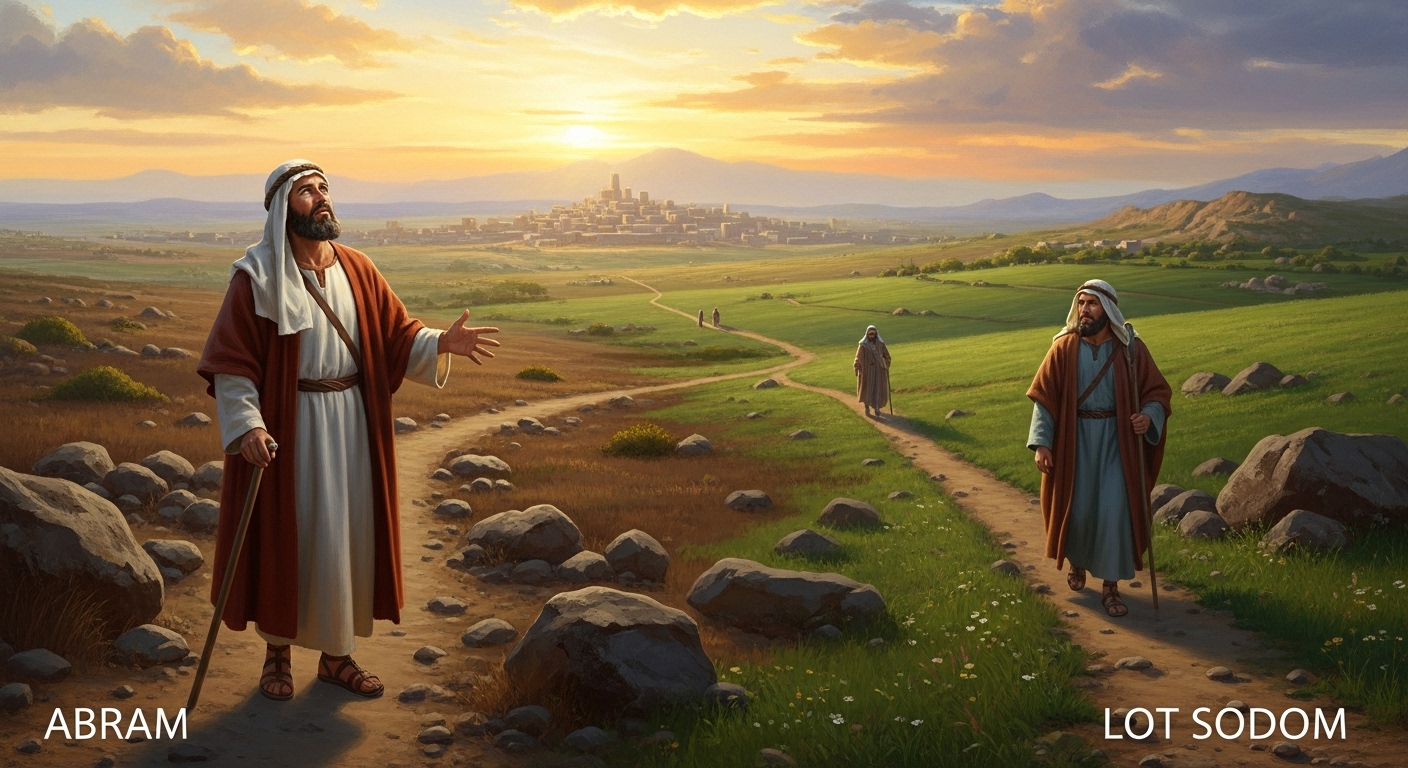
What was Lot’s criterion for choosing? It says he “looked up.” He looked at visible wealth.
The whole plain of the Jordan was well-watered, like the garden of the Lord. So Lot chose the direction of Sodom.
What about Abram? He accepts what is left. He depends on God’s promise and yields. There is an important lesson here. When we judge only by what is visible, we often overlook spiritual danger. Sodom looked rich, but it was actually a wicked city.
And a true person of faith prioritizes peace and God’s will rather than insisting on his own rights.
But does the person who yields lose out? No, never. Let us see what happens next.
God’s Renewed Promise and the Expansion of Vision (Verses 14–18)
“After” Lot had departed, God spoke to Abram. This timing is important.
God’s revelation comes after letting go of human reliance.
God says:
“Look around from where you are, to the north and south, to the east and west. All the land that you see I will give to you and your offspring forever.” (NIV Gen 13:14–15)
Earlier, it said Lot “looked up.” But now,
God is commanding Abram, “Look around.”
Even though it is the same act of “seeing,” it is completely different.
Lot looked with his own desire. But Abram is invited to see with the eyes of God’s promise.
And the promise is becoming more specific and greater.
He will give all the land he sees “forever.” He will make his descendants “like the dust of the earth,” innumerable.
What did Abram do? He moved again and built an altar in Hebron (חֶבְרוֹן). Worship.
The response of faith is always worship.
Hebron (חֶבְרוֹן) is literally translated from Hebrew as meaning “communion,” “friendship,” or “connection.”
Therefore, “Hebron” is a place name that symbolizes “fellowship with God and connection with people.” ・
• For Abram, Hebron was the “place of peace of mind” given after he separated from Lot and yielded the visible things.
• It was a place where he experienced deep “communion (Hebron)” with God.
Here, Abram becomes a person who relies completely on God’s promise, no longer on his own strength.
Hebron, then, is the place where a believer learns to “live in fellowship with God.”
Summary
Well, this story is not a tale from long ago. It speaks to us today.
Firstly, regarding the response to the calling:
God is still asking us to “come out” today.
It means coming out of sin, out of secular values, and out of a self-centered way of living.
Just as Abram left everything and departed, we may need to let go of something.
But that is for a much greater blessing.
Secondly, regarding the journey of faith:
Christian life is a journey, not a destination.
We will make mistakes along the way.
Abram failed, too. But it is okay. We can be restored by God’s grace.
The important thing is to return to Bethel when we fail, which means returning to God.
Thirdly, regarding the power of yielding:
The world today tells us, “Insist on your rights.” But the Bible teaches something different.
The person of faith experiences God’s blessing by yielding.
Abram yielded, but did he lose out? No, God gave him a much richer promise.
Fourthly, regarding God’s faithfulness:
Finally, this may be the most important thing.
Even when we are unfaithful and fail, God is faithful to His promise.
Through whom was God’s plan to bless all humanity through Abraham finally fulfilled?
Jesus Christ. Jesus came as a descendant of Abraham and brought blessing to all of us.
[Invitation]
My beloved friends, and those who have joined us online.
Genesis Chapters 12 and 13 show a complete cycle of the life of faith:
God’s calling, our response, failure, restoration, and God’s unchanging faithfulness.
The Bible records that Abram “went, as the Lord had told him.” (NIV Gen 12:4)
He did so immediately. He obeyed without argument or delay.
What will you do today?
If you have not yet believed in Jesus Christ, today is the day of salvation.
God promised to bless all humanity through Abraham. That promise was fulfilled in Jesus Christ.
Christ died on the cross as a substitute for your sin, was buried, and rose again on the third day.
Whoever believes in this Christ is saved from “the penalty of sin, eternal death, the evil of Satan, and despair,” and is brought to “forgiveness, life, peace, and hope.”
If you are already a Christian, is there anything God is asking you to let go of now? Is there anything He is asking you to obey?
Please open your heart today and respond to God’s invitation.
Bow your head and quiet your heart.
And listen to what the Holy Spirit is speaking to you.
(Prayer)
Heavenly Father, we thank you for your word today.
We praise you for calling and guiding Abram, and for not abandoning him even when he failed.
Please speak to each and every person here today.
Grant salvation to those who need it, restoration to those who need it, and courage to those who need it.
May we respond to your calling and walk by faith. We pray this in the name of our Lord Jesus Christ. Amen.


コメント (手動承認)