Worship Message September 14
The Special Creation of Man, the Garden Mandate, and the Origin of Marriage
Genesis Chapter 2 describes:
- The special creation of humans.
- The mandate and prohibition in the Garden of Eden.
- The origin of the relationship between man and woman, and marriage.
It focuses on “human life” and explains in detail the grand flow of creation described in Chapter 1. Unlike Chapter 1, which paints the whole picture of creation, Chapter 2 focuses on the creation of man and the Garden of Eden. This chapter gives us the details about the start of God’s personal relationship with humans and the role and responsibilities He gave to them.
The Special Creation of Man
The Completion of Creation (Verses 1–3): God finished the work of creation in six days and rested on the seventh day. The Hebrew word here is Shavat (שָׁבַת), meaning “to rest” or “to stop.” This shows that God’s creation was perfect and full of blessing.
Exodus 20 and Deuteronomy 5—the Fourth Commandment God gave to Moses on Mount Sinai after the exodus from Egypt—says: “Remember the Sabbath day by keeping it holy.”
In Hebrew, we greet each other with “Shabbat Shalom” (שבת שלום), which means “peaceful Sabbath.” Shalom is a multi-meaning word used for “hello” and “goodbye.” The Sabbath is the memorial day of Creation.
Besides the word Shavat (to rest), there is another Hebrew word: Menukhot (מְנֻחוֹת). In Psalm 23:2, David sings, “He makes me lie down in green pastures, he leads me beside quiet waters.” The phrase for “quiet waters” is ‘al mei menukhot yenahaleini (עַל־מֵי מְנֻחוֹת יְנַהֲלֵנִי), which literally means “waters of rest.” In the context of the psalm, this is a picture of the Shepherd (the Lord) leading the sheep (us) to a calm waterside (literally “waters of rest”). This symbolizes peace of mind, a rest that is not just physical, but where the soul is filled and secure. This word expresses the complete rest and quietness that God gives.
This is a foreshadowing of the Messianic rest—the true rest that Jesus Christ promises later on (Matthew 11:28–29): “Come to me, all you who are weary and burdened, and I will give you rest. Take my yoke upon you and learn from me, for I am gentle and humble in heart, and you will find rest for your souls.” This is a blueprint for the eternal rest in God’s master plan for the new heaven and new earth.
Commentary on Genesis 2:4
Genesis is the opening book of the 66 books of the Bible, recording the beginning and the source of humanity. It also compresses a vast history of about 2,300 years—from Adam to the death of Joseph—into just 50 chapters. God recorded His redemptive providence, generation by generation, over this incredibly long period in the form of “genealogies,” marking a transition point in the story.
The phrase “This is the account…” uses the Hebrew word Tol’dot (תּוֹלְדֹת), which means “history,” “genealogy,” or “a record of events.” It appears repeatedly, marking divisions or new developments in the narrative (like Noah’s story or Abraham’s story). The genealogy of Jesus Christ in Matthew’s Gospel, which starts, “This is the genealogy of Jesus the Messiah the son of David, the son of Abraham,” follows this Tol’dot format.
The importance of reflecting on the origin of life
This verse teaches us the importance of remembering our beginnings—looking back at the origins of our own lives and faith journey is encouraging.
The Appearance of God’s Name:
In Genesis 1, the name used was “God” (Hebrew: Elohim – אֱלֹהִים), but in Chapter 2, the name “the LORD God” (Hebrew: Yahweh Elohim – יהוה אֱלֹהִים) appears. The name “LORD” (Yahweh) is a proper noun that indicates the personal covenant God who made a special agreement with the people of Israel. This shifts the narrative from the creation of the cosmos to describing God’s personal relationship with humanity.
To value the relationship with God
The name Yahweh Elohim shows that God is not a distant being but is committed to having a close, personal relationship with each of us. This reminds us to be conscious of the fact that “the LORD is with me” in the small details of our daily lives—our work, home, and relationships—which enriches our faith.
The Order of Creation
- “This is the account of the heavens and the earth when they were created.”
This part is the conclusion of the creation story from Genesis 1:1 to 2:3. This summary format ends the grand scale story of how God created the universe.
- “when the LORD God made earth and the heavens.”
From here, the focus of the story shifts to a more limited scope. The order is reversed—from “Heaven and Earth” in Chapter 1 to “Earth and Heaven” here. This reversal suggests that the narrative will now center on the “earth,” where humans live, rather than the entire cosmos.
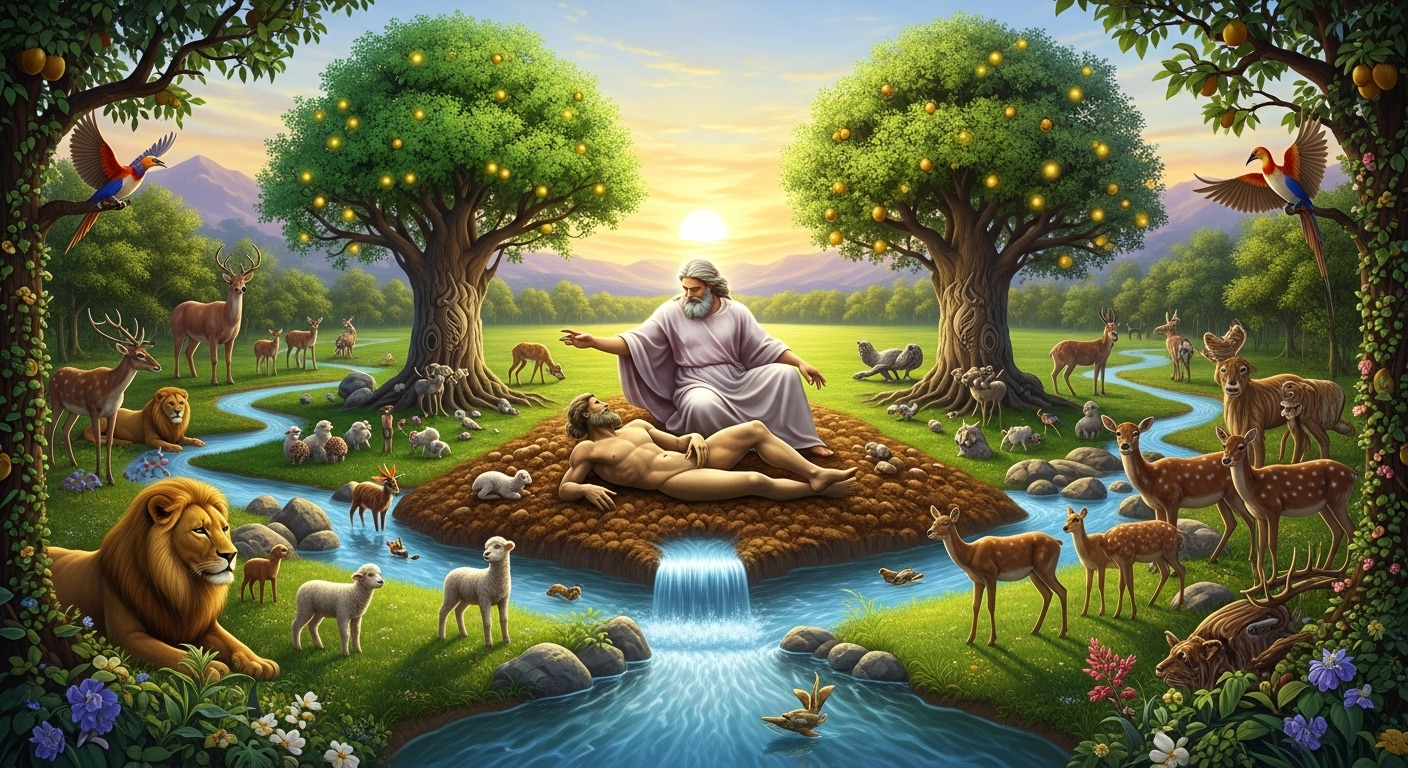
Genesis 2:4, therefore, serves as an introduction, transitioning the magnificent cosmic creation story into a more personal and detailed narrative that focuses on the relationship between God and man.God formed the man (Adam) from the dust of the ground and breathed into his nostrils the breath of life, and the man became a living being. This suggests that humans are both material beings and spiritual beings, animated by the breath of God.
Genesis 2:4 onwards is the summary of creation and, at the same time, the prologue to human history. From here, the relationship between God and man, life in the Garden of Eden, and the story of humanity unfold.
God’s big plan and my little steps
In Genesis Chapter 2, the focus shifts from the grand, cosmic creation in Chapter 1 to a single human being, Adam. God is the one who created the cosmos, but He is also the one who cares about my small life.
The Mandate and Prohibition in the Garden of Eden
The Garden of Eden and the Role (Verses 8–15):
God planted the Garden of Eden for Adam and placed him there. The garden was beautiful, full of trees, and in the center were the “tree of life” and the “tree of the knowledge of good and evil.” God commanded Adam to work it and take care of it. This meant that humans were not just tenants but had the responsibility to manage the earth as God’s representatives.
The Single Prohibition (Verses 16–17):
God allowed Adam to eat freely from every tree in the garden but commanded him not to eat from the “tree of the knowledge of good and evil.” This command was a test of trust and obedience in the relationship between God and man.
The “Edenic Covenant,” though not named in the Bible, is a theological term for the agreement made between God and man (Adam), summarizing the command, blessing, and warning God gave him.
The Warning Against Disobedience (Genesis 1:29-30,2:16-17): God allowed them to eat fruit from every tree in the garden. This symbolized the rich blessing and abundance God gave to humanity. However, there was only one prohibition: they were absolutely not to eat from the “tree of the knowledge of good and evil.”
The consequence for disobeying the prohibition was clearly stated: (Genesis2:17) “but you must not eat from the tree of the knowledge of good and evil, for when you eat from it you will certainly die.” This “death” meant not just physical death, but spiritual death—the severing of the relationship with God.
The Theological Meaning of the Edenic Covenant
- A conditional covenant: The Edenic Covenant is seen as a “conditional covenant” because God’s blessing and life depended on human “obedience.”
- The trial of free will: This was an important test to build a relationship of trust between God and man, who had been given free will.
- The breaking of the covenant: Unfortunately, this covenant was broken when Adam and Eve ate the fruit. This event became the “original sin” taught in the Bible, the cause of sin and death being brought upon all humanity. The Edenic Covenant is the starting point for God’s entire plan of salvation throughout the rest of the Bible. After humans broke the covenant, God prepared the way to save humanity from sin and death through new covenants (like the Abrahamic and New Covenant through Christ).
The Origin of the Relationship Between Man and Woman and Marriage
The Creation of the Woman and the Origin of Marriage (Verses 18–25): God said it was “not good for the man to be alone,” and created a suitable helper for him (Eve). Adam named the animals, but no helper suitable for him was found. So, God made the woman from the man’s rib and brought the two together. This event teaches us that the institution of marriage was established by God, and the ideal is for the man and woman to “become one flesh.”
The Hebrew original words are:
Man = ’ish (אִישׁ) and
Woman = ’ishshah (אִשָּׁה).
These two words—’ish and ’ishshah—are a pair that, both linguistically and theologically, signify “mutual complementation and unity.” Genesis 2 conveys a linguistic beauty unique to Hebrew: that the woman was made from the man, but the man is also completed by the woman.
- The institution of marriage is an order established by the Creator, not a mere product of human society.
- This is a crucial verse that is spiritually interpreted in the New Testament as the pattern of love between Christ and the Church.
Verse 25: They were “naked” (Hebrew: arummim – עֲרוּמִּים). This describes their state of having no clothes, but it doesn’t mean “weakness” or “lack.” Rather, it refers to a state of “being as they were” or “innocence.”
“And they felt no shame.”
Shame (Hebrew: bush – בּוּשׁ) is an emotion that arises as a result of sin or distrust.
At this point, since sin had not yet entered, the relationship with God and the relationship between the man and woman were based on complete trust and transparency.
Contextual meaning
A contrast with Genesis 3 is important:
- 2:25 → Naked and felt no shame (innocence, trust).
- 3:7 → Immediately after sinning, they were ashamed of their nakedness and covered themselves with fig leaves.
The meaning of “nakedness” changed depending on the presence or absence of sin.
Verse 25 depicts the ideal state of humanity before the Fall.
Naked = an authentic existence.
No shame = there was no sin, and the relationship with God and the relationship between the couple were in perfect harmony.
This is the portrait of humanity before the “Loss of Paradise,” and it is also a foreshadowing of the final restoration in Christ (the new heaven and new earth).
Genesis Chapter 2 Summary
Genesis Chapter 2 teaches us about the intimate relationship between God and humanity, the dignity of labor, the origin of marriage, and the importance of obeying God’s command. It shows the perfect and peaceful state of humanity before sin entered the world.

コメント (手動承認)