Worship Message No. 18_January 11: Revelation Chapter 2
Scripture: Revelation Chapter 2 (Letters to Ephesus, Smyrna, Pergamum, and Thyatira)
Introduction: The Presence of the One with Eyes Like Blazing Fire
Dear brothers and sisters. We are here today to listen deeply to the speaking of the Holy Spirit.
Before the Book of Revelation is a book of riddles about the distant future, it is the “revelation (appearing) of Jesus Christ.”
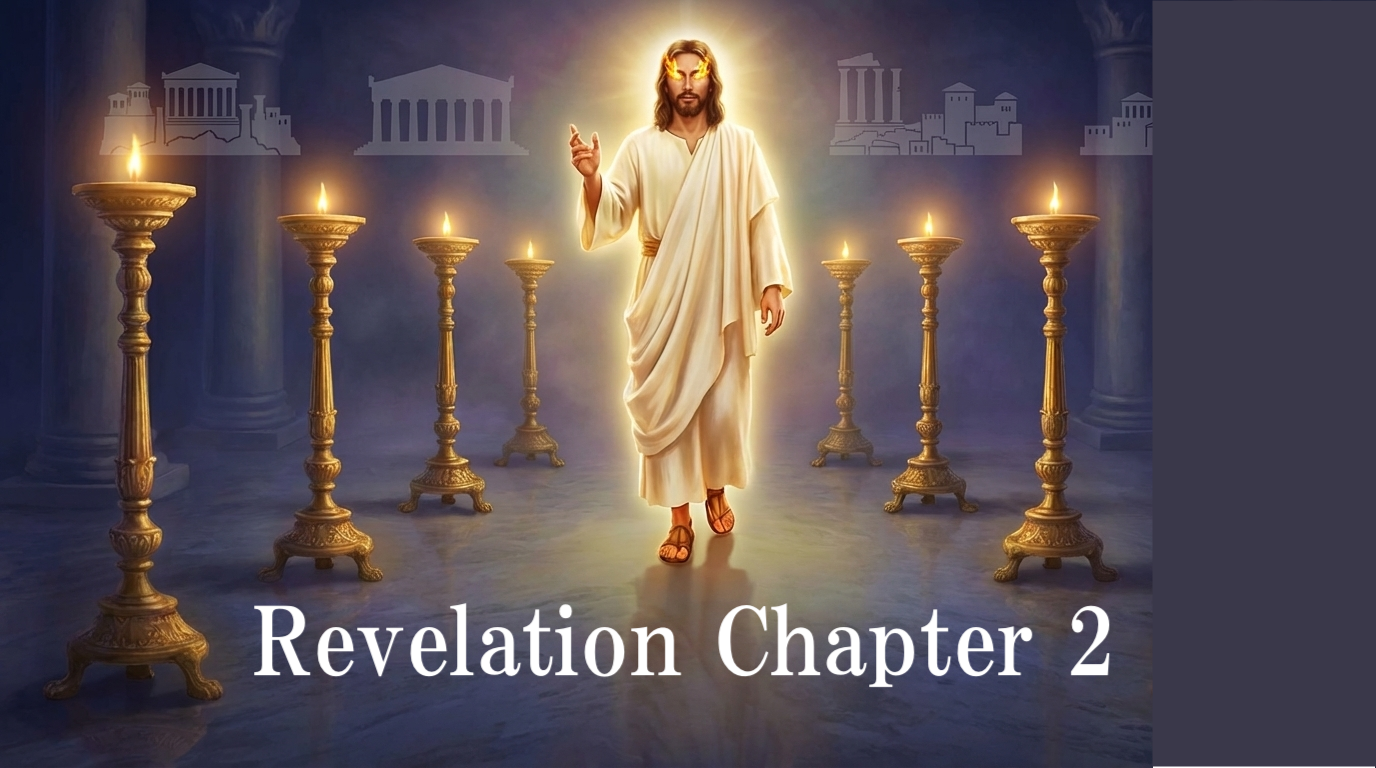
In chapter 1, we saw the Lord in His glory. His eyes were like blazing fire, and His feet were like bronze glowing in a furnace.
And most importantly, there is the fact that the Lord “walks among the seven golden lampstands” (2:1).
The lampstands represent the churches. In other words, the Lord Jesus is not in some far-off heaven. Right now, He is walking in the “midst” of this sanctuary and our fellowship, looking at the condition of each person’s heart and the spiritual temperature of the church with those flame-like eyes.
“Whoever has ears, let them hear what the Spirit says to the churches”
When we confirm our understanding of the overall structure, we see a common pattern in the messages to the seven churches:
The self-introduction of Christ
“I know your deeds”
Commendation and rebuke
A call to repentance
A promise to the one who is victorious
“Hear what the Spirit says to the churches”
In short, the Lord sees, evaluates, and seeks to heal.
Today, through the letters to the four churches recorded in Revelation chapter 2, the Lord hands us a “medical report.”
Let us open our hearts to this message, which is stern because of His love, yet overflowing with life.
Let us look at them one by one.
1. The Church in Ephesus — “Love” or “Rightness”? (2:1-7)
First, the Lord speaks to the church in Ephesus. Ephesus was a major city of that time and a place of intense spiritual warfare.
The Self-Introduction of Christ
The Lord appears as the one “who holds the seven stars in his right hand and walks among the seven golden lampstands” (v. 1). This is His appearance as the Sovereign of the church, the one who protects and leads it.
Points of Commendation
The Ephesian church excelled in their deeds, hard work, and perseverance. They saw through false apostles, rejected heresy, and endured for the sake of the Lord’s name. From the outside, it was a model church.
The Fatal Problem
However, the Lord says: “You have forsaken the love you had at first” (v. 4). This is a serious spiritual condition.
What is this “first love (prote agape)”? It does not simply refer to the emotional excitement when one was first saved. It means “the love that puts Christ Himself above all else.”
Even with orthodox doctrine, zealous service, and moral purity—if love for Christ had grown cold, they had everything but the essential.
Everyone, what does “forsaking your first love” specifically mean? Imagine a married couple.
There is a husband who fulfills his duties to his wife perfectly. He brings home every cent of his salary. He repairs the house. He always buys a specific bouquet for their anniversary. He never commits adultery. To those around him, he is a “model husband.”
However, he hasn’t looked into his wife’s eyes and talked to her for years. He doesn’t say “I love you,” and he pays no attention to what makes her happy or sad. He is simply performing his “role as a husband” mechanically.
If the wife asks, “Honey, do you love me?” he might answer irritably, “What are you talking about? Don’t I work every day? Don’t I bring home the money? What else do you want?”
…Everyone, this was exactly the state of the Ephesian church. They said to God, “Lord, we fought against heresy! We served! We studied the Bible! Is there a problem?”
The Lord Jesus says sadly, “Yes, you are right. But your eyes are no longer looking at Me. You are doing ‘My work,’ but you do not love ‘Me’ anymore.”
“First love” is not about a surge of emotion. It is about “relationship.” Has the busyness of service stolen your intimate fellowship with the Lord? Have we become “employees” of Jesus today? Before being a capable worker, what the Lord desires is a beloved bride.
Application
We are in the same danger. While busy with church activities and diligent in service, has our personal fellowship with the Lord become a mere formality? Are we serving out of a sense of obligation, having lost the joy and passion we had at the beginning?
The Solution
The Lord gives three commands:
Remember—where you once were.
Repent—a change in the direction of your heart.
Do the things you did at first—actions that spring from love.
This is not just a matter of feelings, but a repentance accompanied by specific actions. Before the lampstand (the testimony of the church) is removed, we must regain our first love.
- Interpretation of “The Fruit of the Tree of Life” (v. 7)
The promise in Revelation 2:7, “To the one who is victorious, I will give the right to eat from the tree of life, which is in the paradise of God,” is a vital symbol that runs through the entire history of salvation in the Bible.
- Connection to Genesis:
The Lost Blessing
In Genesis 2:9, the “tree of life” and the “tree of the knowledge of good and evil” were in the middle of the Garden of Eden. Humans sinned by eating from the tree of the knowledge of good and evil, and as a result, they were distanced from the “tree of life” (Genesis 3:22-24). Cherubim and a flaming sword that turned every way were placed there, and humans could no longer approach the tree of life.
- Connection to Revelation 22
In Revelation 22:2 and 14, this theme of the “tree of life” reappears:
“On each side of the river stood the tree of life, bearing twelve crops of fruit, yielding its fruit every month,” and
“that they may have the right to the tree of life and may go through the gates into the city.”
This shows the completion of the history of salvation. What was lost in Genesis is restored in Christ.
Eschatological Hope
This is not a mere metaphor; it refers to the actual blessed state in the New Heaven and New Earth. God has prepared a wonderful future for us that exceeds our imagination.
Summary of “The Fruit of the Tree of Life”
The “fruit of the tree of life” symbolizes that the blessing lost at the Fall is restored through the redemption of Christ and is eternally guaranteed. It signifies complete fellowship with God, incorruptible eternal life, and perfect satisfaction and joy—the ultimate promise of the Gospel.
2. The Church in Smyrna — “Wealth” in the Midst of Suffering (2:8-11)
The Self-Introduction of Christ
“The First and the Last, who died and came to life again”—this is the most powerful encouragement for a church under persecution.
The Situation
The Smyrnaean church was in “afflictions and poverty.” Yet the Lord says, “yet you are rich!” This is spiritual wealth. They were facing slander from Jews and upcoming imprisonment and trials.
Promise and Command
The Lord tells them they will “suffer persecution for ten days,” indicating a limited period. He then commands, “Be faithful, even to the point of death.” This is a command that includes the possibility of martyrdom.
The Reward
The “victor’s crown” (the crown of life) is promised. They will not be “hurt at all by the second death” (eternal destruction).
Application
Today, in many places around the world, Christians are being persecuted. While we pray for them, we also face various forms of “affliction” in Japan, such as the pressure of secularization, opposition from family, or isolation in the workplace. The Lord did not offer any rebuke to the church in Smyrna. Faithfulness in the midst of suffering is what the Lord values most.
3. The Church in Pergamum: The Disease Named Compromise (2:12-17)
The Self-Introduction of Christ
“The one who has the sharp, double-edged sword”—He appears as the one who separates truth from falsehood by His Word.
Commendation
Pergamum was called the place “where Satan has his throne” and was a center of pagan worship. Yet they remained true to His name and did not renounce their faith in the Lord even after the martyr Antipas was put to death.
The Problem
However, there were those in the church who held to the “teaching of Balaam” and the “teaching of the Nicolaitans.” This is a mixture of faith and secular compromise. Balaam led Israel into idolatry and sexual immorality. Similarly, part of the Pergamum church was teaching compromise with pagan society.
Warning
The Lord says, “Repent therefore! Otherwise, I will soon come to you and will fight against them with the sword of my mouth.” The sin of individuals becomes the responsibility of the entire church.
Application
We also face various temptations to compromise today:
Conforming to unjust practices in business
Accepting secular values
Relaxing the ethical standards of the Bible
The church is an existence that is “in the world but not of the world.” We are called to stand in truth with love. Tolerance is different from compromise. The holiness of the church is born not from exclusivity, but from faithfulness to Christ.
The Promise
To the one who is victorious, “hidden manna” and a “white stone” will be given. These symbolize intimate fellowship with the Lord and a new identity.
Now, the Lord Jesus said to the church in Pergamum, “I know where you live—where Satan has his throne.”
This is not a mere metaphor. For the Christians living in Pergamum at that time, this was an intimidating and terrifying daily reality they saw with their own eyes.
Overlooking the city of Pergamum, on a high hill (the Acropolis), stood the massive “Great Altar of Zeus.” Standing over 10 meters high and shaped like a horseshoe, it looked exactly like a “giant throne” set upon the mountain when viewed from a distance. The smoke from sacrifices offered to pagan gods rose from there all day long.
Furthermore, Pergamum was a center of “Emperor Worship.” At that time, it was a national duty to worship the Roman Emperor as a god. Once a year, one had to burn incense to the statue of the Emperor in the temple and confess, “Caesar (the Emperor) is Lord.” Doing so would grant a certificate, allowing one to do business and protect their livelihood.
However, Christians would say, “No, Jesus alone is Lord.” What would happen then? They were cursed as “un-patriotic” or “atheists,” excluded from society, and sometimes their lives were taken.
In other words, the Lord’s words, “I know where you live—where Satan has his throne,” mean this: “I know the pressure you are living under. When you look up at the city, there is the symbol of Satan, and the very structure of society pressures you to abandon your faith. Even in the middle of enemy territory, you are holding fast to My name.”
The Lord understands the severity of their environment more deeply than anyone else, and based on that, He encourages them.
4. The Church in Thyatira: The Inner Enemy (2:18-29)
The Self-Introduction of Christ
“The Son of God, whose eyes are like blazing fire and whose feet are like burnished bronze”—this is the Lord’s appearance as the Holy Judge.
Commendation
The church in Thyatira was growing in love, faith, service, and perseverance. It says, “you are now doing more than you did at first,” which is in contrast to Ephesus.
The Serious Problem
However, a woman called “Jezebel,” acting as a prophetess, was teaching within the church and leading people into sexual immorality and the eating of food sacrificed to idols. The Jezebel of the Old Testament was the queen who led Israel into Baal worship. Here too, the problem was spiritual corruption from within the church.
The Lord gave her time to repent, but she was unwilling. Therefore, a severe judgment was declared.
To the Faithful Remnant
The Lord does not impose “any other burden” but encourages them, saying, “only hold on to what you have until I come.”
Application
Modern churches must also be on guard against false teachings from within. Teachings that speak of grace but disregard holiness, teachings that emphasize only success and prosperity, or teachings that lean toward relativism—”Jezebel” appears in various forms.
- Conclusion
We have looked at four churches from Revelation chapter 2. Ephesus, which was losing its love; Smyrna, in the midst of suffering; and Pergamum and Thyatira, which were compromising with the world. Though each situation is different, there are words the Lord always repeats at the end:
“Whoever has ears, let them hear what the Spirit says to the churches.” “To the one who is victorious, I will give…”
The Lord does not desire for us to end in defeat.
To burn with love like Ephesus,
to endure suffering like Smyrna,
and to live in truth without being stained by the world like Pergamum and Thyatira.
That is what it means to be “the one who is victorious (an overcomer).”
Today, the Lord still says, “I know your deeds.”
This is not a threat, but the gaze of a loving Lord. The Lord knows all your hard work and your weaknesses.
How can we be victorious? It is not by our own strength. As Revelation 12:11 says, “They triumphed over him by the blood of the Lamb and by the word of their testimony.”Today, the Lord is walking among us. His blazing eyes are illuminating your heart.
If you have lost your “first love,” let us repent today. If you are in the midst of suffering, find rest in the Lord’s words, “I know.” If you are in compromise, let us cut it away with the sword of the Holy Spirit.
Lord, open our ears. May we obey the voice You are speaking right now.
- Prayer
Lord Jesus, who walks among the lampstands. We thank You that Your flame-like gaze has illuminated our hearts today.
Please set ablaze once more the cold love within us.
Help us to cast away compromise with the world and be those who partake in Your holiness.
This week, please pour out the anointing of the Holy Spirit so that we may walk as “overcomers” in our respective places.
We pray in the name of the Lord Jesus Christ. Amen.
コメント (手動承認)