Worship Message No. 17_January 04
[Introduction: Clearing Misunderstandings about Revelation]
Good morning, everyone.
From today, we will begin studying the “Book of Revelation” together.
When you hear the word “Revelation,” what kind of image do you have?
Many people might feel a bit guarded, having images of a “terrifying book of prophecies about horrific disasters” or a “puzzling book featuring eerie beasts.”
However, in reality, this Book of Revelation was not written to cause fear.
Rather, it is a book written to raise up the church that is in the midst of suffering.
It is not meant to show “future terrors,” but to clearly show us the
“true form of Jesus Christ,” our Savior.
Chapter 1, which we read today, serves as the “cover” of the entire Book of Revelation and is a chapter packed with its “central message.”
From the Origin of Revelation to its Transmission (Verses 1-3)
In order to reveal His hidden plan of salvation,
God gave the revelation to Jesus Christ.
It was then communicated through an angel to John, who was in exile on the island of Patmos, and further transmitted to us (the believers).
At the beginning, verse 1 of chapter 1 says:
“The revelation from Jesus Christ.”
This word “revelation” is “apokálypsis” in Greek, which means “to remove a covering,” “to unveil,” or “to make clear.”
In other words, this is not a book to frighten us, but
“a book that reveals the truth of Jesus Christ and gives us hope.”
In verse 3, the “first blessing” is declared: the one who reads aloud the words of this prophecy, those who hear it, and above all, those who take to heart (keep/obey) what is written in it in their lives are “blessed” (Greek: makarios).
In Revelation, seven “blessings” are recorded (refer to PDF).
The Greek word for “blessed (blessing)” in the plural form (blessed are those…) is μακάριοι (makarioi).
This is the same word used in the “Sermon on the Mount” in the New Testament, and it refers not to a mere temporary happiness, but to a deep spiritual joy—the state of being under God’s grace.
In Revelation, the singular form (blessed is the one…) μακάριος (makarios) is also used.
For future reference, I will read the beginning of each passage:
• 1:3 — μακάριος ὁ ἀναγινώσκων… (makarios ho anaginōskōn) “Blessed is the one who reads aloud…”
• 14:13 — μακάριοι οἱ νεκροὶ οἱ ἐν κυρίῳ ἀποθνῄσκοντες… (makarioi hoi nekroi hoi en kyriō apothnēskontes) “Blessed are the dead who die in the Lord…”
• 16:15 — μακάριος ὁ γρηγορῶν… (makarios ho grēgorōn) “Blessed is the one who stays awake…”
• 19:9 — μακάριοι οἱ εἰς τὸ δεῖπνον τοῦ γάμου τοῦ ἀρνίου κεκλημένοι… (makarioi hoi eis to deipnon tou gamou tou arniou keklēmenoi) “Blessed are those who are invited to the wedding supper of the Lamb!”
• 20:6 — μακάριος καὶ ἅγιος ὁ ἔχων μέρος ἐν τῇ ἀναστάσει τῇ πρώτῃ… (makarios kai hagios ho echōn meros en tē anastasei tē prōtē) “Blessed and holy are those who share in the first resurrection.”
• 22:7 — μακάριος ὁ τηρών… (makarios ho tērōn) “Blessed is the one who keeps (the words)…”
• 22:14 — μακάριοι οἱ πλύνοντες τὰς στολὰς αὐτῶν… (makarioi hoi plynontes tas stolas autōn) “Blessed are those who wash their robes…”
Regarding these seven,
although Revelation is often thought of as a “book of judgment,” when we focus on the fact that μακάριος (makarios) is repeated seven times, the message is that
“the essence of this book is to assure the members of the church in the midst of hardship of ‘God’s blessing’.”
• The latter part of verse 3 says, "the time is near." This is not a threat saying, “The world is ending soon, so hurry up and do something.” Rather, it is a loving invitation: “No matter how dark it looks now, the time of God’s victory is just around the corner. Therefore, do not be swallowed up by current hardships, but remain in the Word of God. For that is the greatest blessing (makarios) that will sustain you until the end.”
Let me explain “the time is near” in more detail.
It does not mean that the clock time (Chronos) is short, but it expresses the urgency that
God’s decisive time (Kairos) is imminent.
[In the Bible, there are two concepts of “time”]:
the two concepts of “time” called Chronos (Χρόνος) and Kairos (Καιρός).
Since we cannot understand the Bible correctly without knowing these, I will explain them (refer to PDF).
In Revelation chapter 1, urgent expressions regarding time appear, such as “soon” (1:1) and “the time is near” (1:3).
① The Chronos Perspective: Waiting and Patience (1:1)
Meaning: Refers to things progressing in order and quickly.
Explanation: “Soon (en takei)” does not just mean a sense of speed like “in 5 minutes,” but implies a continuity where “once it starts, it won’t stop” or “it will be fulfilled all at once.” it shows that God’s plan is steadily progressing within the framework of human history (Chronos).
② The Kairos Perspective: God’s Intervention and Proclamation (1:3)
Meaning: Refers to a “meaningful, special time” or “God’s opportune moment.”
Explanation: “The time (Kairos) is near” in 1:3 is not a matter of the number of pages on a calendar. It is a spiritual proclamation: “The window of salvation history is about to close,” and “the moment when God’s reign is decisively revealed is right in front of our noses.”
Application to the Sermon: We are not just living through days of turning calendar pages (Chronos). We are standing right before the “decisive moment (Kairos)” where it would not be strange to face the Lord at any time.
Introduction: Which “time” are we living in?
We tend to fall into Chronos-style calculations like “How many more years until the Second Coming?” However, what Revelation teaches is Kairos—the tension of “now, this moment is God’s time.”
Main Point: The Intersection of Two Times
The Suffering of Chronos: For John, who was in persecution, Chronos (the days of exile) must have been long, tedious, and painful.
The Intervention of Kairos: However, on the “Lord’s Day (1:10),” Kairos pierced into Chronos. When the Lord of glory appeared, the “meaning of time” for John was completely rewritten.
Conclusion: The Blessing of Living in Kairos
The word “Blessed” in 1:3 is a blessing for those who live consciously of Kairos.
Because “the time (Kairos) is near,” we love now, repent now, and witness now.
Let’s review the two “words” we learned in Luke chapter 2.
We learned that in Greek, there are “Logos” and “Rhema” for word.
The difference between “Logos” and “Rhema” can be compared to the difference between “musical notation (a score)” and a “performance.”
Metaphorically interpreted, “Logos” is the “score.” It contains universal and perfect truth, but it is information on paper.
On the other hand, “Rhema” is the “performance” where that score is actually played as sound. It refers to the “event” itself where the sound resonates before your eyes (the spoken word), the air vibrates (powerful intervention), and it reaches the listener’s heart directly (individual application).
• Greetings from the Triune God (Verses 4-5a) John records greetings from the Triune God in the form of a letter to the seven churches in Asia.
God the Father is shown as the one “who is, and who was, and who is to come,” which is an expansion of “I AM WHO I AM” from Exodus 3:14, revealing Him as the Sovereign who rules over all history.
The Holy Spirit is represented as “the seven spirits before his throne,” a symbolic expression of the perfect Holy Spirit based on Isaiah 11:2 (seven being the number of perfection).
God the Son, Jesus, is called by three titles:
“the faithful witness” (the prophetic office of witnessing to the truth even unto death),
“the firstborn from the dead” (the priestly office as the firstfruits of the resurrection), and
“the ruler of the kings of the earth” (the kingly office stating that Christ, not Caesar, is the true King).
• The Work of Christ and the New Status of Believers (Verses 5b-6) Here, praise (doxology) is offered, and the timeline of Christ’s work is clearly shown.
First, Christ “loves us” (present tense, continuous love),
then He “has freed us from our sins by his blood” (aorist tense, a completed past event),
and He “has made us to be a kingdom and priests” (current new status).
The grace of salvation unfolds in this order.
We are not just “saved individuals,” but
we are given the glorious status of “priests” who serve God.
• Proclamation of the Second Coming—The Theme Song of Revelation (Verse 7) Verse 7, which says, “‘Look, he is coming with the clouds,’ and ‘every eye will see him, even those who pierced him’; and all peoples on earth ‘will mourn because of him.’ So shall it be! Amen,” is the theme song of the entire Book of Revelation and contains three truths.
First, “coming with the clouds” is a quote from Daniel 7:13 in the Old Testament. In the Bible, clouds represent God’s presence (Shekinah), meaning that Jesus will return not in His former “weak and poor form,” but as a public King clothed in the majesty of God who governs the entire universe.
Second, “every eye… even those who pierced him; will see him” is a quote from the prophecy in Zechariah 12:10.
The Second Coming of Christ is an event that people all over the world will witness simultaneously, and even those who mocked Jesus on the cross and rejected God will be forced to acknowledge that He was the true Lord.
Third, “all peoples on earth will mourn” includes both the “mourning of repentance” where people realize their own sinfulness before such great glory, and the “mourning of judgment” where those who lived relying on their own power and wealth fall into despair. John, with the words “So shall it be! Amen,” sincerely longs for the end of the world where evil flourishes and the beginning of the Lord’s righteous reign.
• Self-Proclamation of the Almighty (Verse 8) God declares, “I am the Alpha and the Omega.”
As many of you likely know, these are the first and last letters of the Greek alphabet.
This represents God as the Beginner and Completer of history, and the Almighty (Greek: Pantokratōr) signs this as a guarantee of the truthfulness of this book.
In an era when the Roman Emperor Domitian called himself “Lord and God,” this stands as a powerful counter-message declaring,
“No, this One is the Almighty.”
• John's Situation and the Beginning of the Vision (Verses 9-10) John introduces himself as “your brother and companion in the suffering and kingdom and patient endurance that are ours in Jesus,” showing that he stands in the same position as the believers.
Because of his testimony for Jesus, he was exiled to the isolated island of Patmos in the Aegean Sea, likely due to persecution by Emperor Domitian.
On a certain Lord’s Day (Sunday, the day of Resurrection), John was “in the Spirit” (in a state of spiritual ecstasy), received a special revelation, and heard behind him a loud voice like a trumpet.
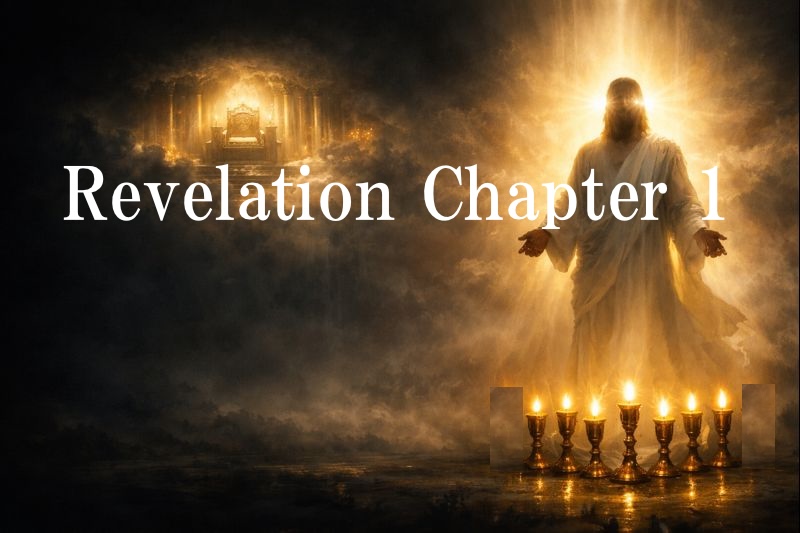
• The Vision of the Glorious Christ (Verses 11-16) When he turned around, John saw seven golden lampstands, and among them stood someone “like a son of man.”
This appearance is set against the background of the visions in Daniel 7:13 and chapter 10; this was not the Jesus described in the Gospels as the “poor son of a carpenter.”
The Lord wore a robe reaching down to his feet with a golden sash (priestly and kingly majesty);
His head and hair were white like wool (Daniel 7:9, eternity and purity);
His eyes were like blazing fire (eyes of judgment that see through everything);
His feet were like bronze glowing in a furnace (firm authority);
His voice was like the sound of rushing waters (a powerful voice of authority);
He held seven stars in His right hand (holding the leaders of the seven churches);
coming out of His mouth was a sharp, double-edged sword (Hebrews 4:12, the power of God’s Word);
and His face was like the sun shining in all its brilliance (the radiance of glory).
Most importantly is “where this glorious Lord was standing.”
The Lord was not far away on the other side of heaven, but was standing “among the seven lampstands (churches).” This is a great comfort.
Even when the church or our lives feel trapped in darkness, the Lord is standing in powerful form right beside that lampstand (church) that illuminates the darkness—right in the middle of it.
• The Proclamation "Do Not Be Afraid" (Verses 17-18) Why is there no need to fear? Because of the overwhelming majesty, John fell at the Lord’s feet as though dead. But the Lord placed His right hand on him to encourage him and declared:
“Do not be afraid. I am the First and the Last. I am the Living One;
I was dead, and now look, I am alive for ever and ever!
And I hold the keys of death and Hades.”
At that time, the greatest fear for Christians was “death.”
It was an era when lives were taken if they went against the Emperor.
However, the resurrected Lord declares: “The one who holds the keys of death is not the Emperor. It is I.
I have overcome death. Therefore, you no longer need to fear death.” This means complete victory over death and the underworld. The one who concludes our lives is not sickness, misfortune, or death, but the Lord Jesus Himself, who says,
“I am the Alpha and the Omega (the First and the Last).”
• Interpretation of the Vision and the Mission (Verses 19-20) The Lord commands John: “Write, therefore, what you have seen, what is now and what will take place later.”
Then the interpretation of the vision is given.
The seven stars are the angels (leaders) of the seven churches, and the seven lampstands are the seven churches.
The fact that the “seven stars” are held in the Lord’s right hand symbolizes that the leaders of the church and the church itself are under the protection and sovereign rule of the glorious Lord.
Some of you may be in the midst of trouble, feeling lonely, or feeling anxious about the future.
But please do not forget. You are held firmly in the “right hand” of that glorious Lord.
The Lord knows all your weaknesses and pains, and He is speaking to you:
“Do not be afraid, I hold the keys.”
[Conclusion]
Revelation chapter 1 asks us this:
“Do you look at the difficulties in front of you?
Or do you look at the victorious Lord standing in your midst?”
In a place of loneliness and hardship called the island of Patmos, John received the most magnificent revelation.
Our places of suffering can also become places of encounter with God.
The theme of Revelation is that
“Jesus Christ is not one who ended in death, but is living and working even now,”
and the fact is that “the victorious Lord is with you now.”
Especially in difficult times, this truth becomes our comfort.
Tomorrow, we will all return to our respective realities.
Difficult problems or loneliness like that of Patmos might be waiting.
However, please remember:
the glorious Lord is placing His hand on your shoulder and saying, “Do not be afraid.”
“I hold the keys to your life. Therefore, walk in peace.”
Let us receive this encouragement from the Lord and walk forward step by step this week.
• Prayer Heavenly Father,
We thank You for teaching us through the words of Revelation today how powerful and merciful our Lord Jesus Christ is.
May the Lord place His powerful right hand on the shoulder of each person who is in the midst of trouble or anxiety and say,
“Do not be afraid.”
May we walk with hope in the days starting tomorrow, together with the Lord who has conquered death and is alive even now.
We pray in the name of the Lord Jesus Christ.
Amen.
コメント (手動承認)