
【SERMON INTRODUCTION】
Good morning, everyone.
“God attempted to kill His servant.”
No, that’s a different passage. But it is related.
Today’s passage contains an even more surprising thing.
A child will be born to a 99-year-old man and a 90-year-old woman.
Medically impossible.
Humanly impossible.
Cannot be explained by common sense.
But that is God’s way.
The following is divided into two chapters:
Chapter 16: The story of people who gave up, saying, ‘It’s impossible now’.
Chapter 17: The story of God who says, ‘I can do anything’.
Is there anything in your life that you think ‘It’s impossible now’?
Is there anything in your situation that you feel ‘It’s impossible’?
Today’s story speaks to you:
“What is impossible with man is possible with God.”
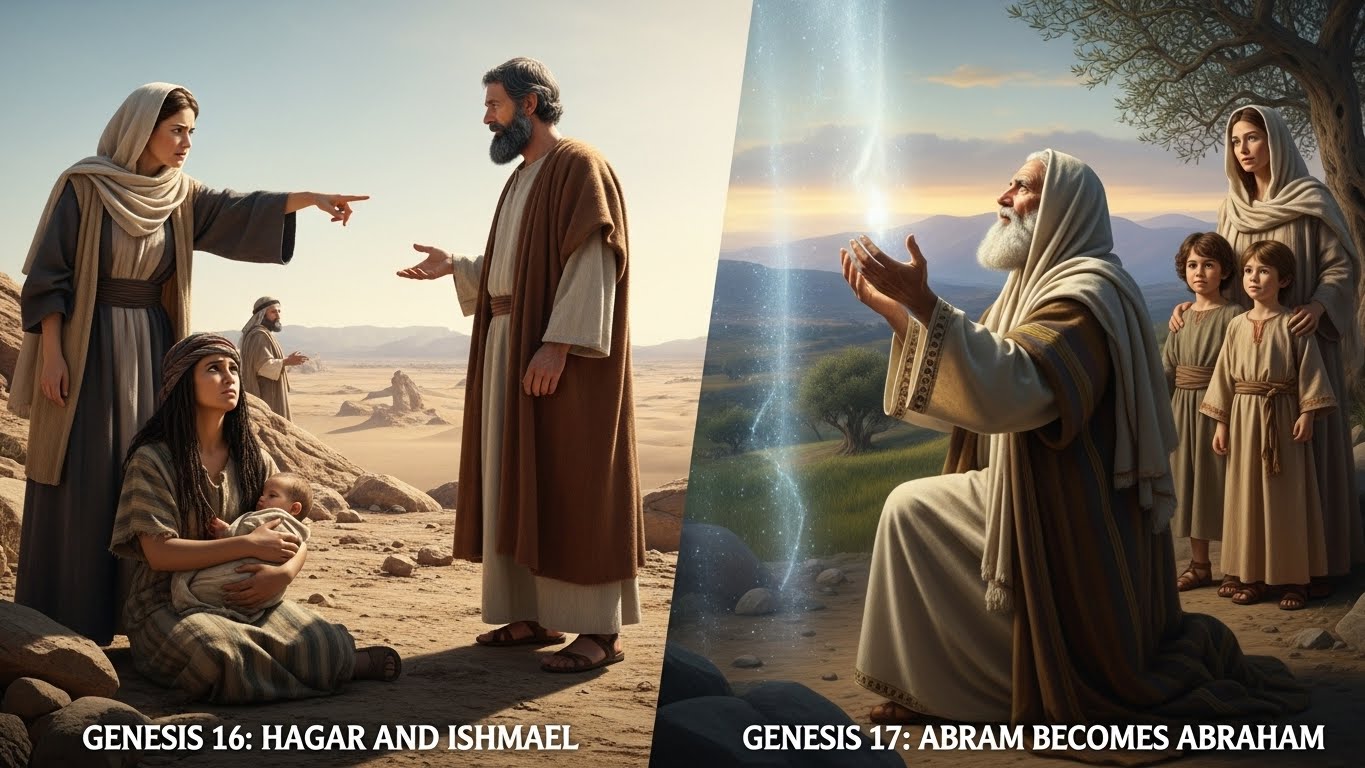
Genesis Chapter 16: The Story of Hagar and Ishmael
Sarai’s Suggestion – The Faith That Could Not Wait (16:1-3)
Everyone, can you understand Sarai’s feelings? God promised a child would be given. But nothing happened no matter how many years she waited. She was already over 75 years old.
So she thought: “Maybe God is expecting us to take some action ourselves.”
In the culture at the time, if a wife could not bear a child, it was a common thing to gain a child through a female slave. In fact, such records remain in ancient legal documents (Nuzi documents). Therefore, this seemed like a reasonable solution to Sarai.
But there is a big problem here. This was a human solution that could not wait and believe in God’s promise.
Are we not the same? We cannot wait for God’s timing, and we try to solve problems by our own methods. When we pray and the answer doesn’t come, don’t we sometimes say, “God, I will do it myself now?”
Conflict Between Sarai and Hagar (16:4-6)
When Hagar became pregnant, what happened? She began to look down on Sarai. Of course that’s natural. A feeling of superiority was born, saying, “I can bear a child, but you cannot.”
And what did Abraham do? He abandoned his responsibility, saying, “That’s your problem. Do as you wish.”
Sarai mistreated Hagar, and Hagar fled.
Look. One human solution gave birth to this much pain and suffering.
Sin is always like this. Something we started thinking, “This much will be fine,” ends up producing unexpected results.
God’s Grace to Hagar (16:7-14)
This is where it gets amazing.
Hagar is fleeing in the wilderness. She is a female slave. In the society of the time, she is the most vulnerable person. An existence that no one cares about.
But God appeared to her, in the form of the “Angel of the Lord”. That is God Himself, who took a visible form to approach humans.
And pay attention. God calls her by name, “Hagar”. This is an amazing thing. God sees her as a person, as an individual.
Hagar says, “El Roi (אֵל רֳאִי),” which means “The God Who Sees Me.”
God sees those whom society abandons. God calls by name those whom no one cares about. When you feel lonely, when you think no one cares about you, God sees you. He knows your name.
Return and the Birth of Ishmael (16:15-16)
The name Ishmael ( יִשְׁמָעֵאל ), this means “God Hears.”
This Ishmael is also an object of God’s care. We will see later, but God also promises a blessing to him.
However, this child is not the child of the covenant, not the child of the promise. That is Isaac, who will be born later.
Lessons to Learn from This Chapter
Waiting for God’s time is truly difficult, but necessary.
Our plan and God’s plan are different. Our methods often cause pain.
But God works even in the midst of our failures.
And God specifically cares for the vulnerable and the forgotten.
Genesis Chapter 17: The Renaming from Abram to Abraham
God’s Reappearance and New Revelation (17:1-2)
Everyone, please compare the end of Chapter 16 and the beginning of Chapter 17. When Ishmael was born, Abram was 86 years old. And in Chapter 17, Verse 1, Abram is 99 years old.
That is, nothing happened for 13 years. God said nothing.
It was 13 years of silence. Abraham might have begun to think, “Ah, Ishmael was the child of the promise after all.”
Then God appeared and said, “I am God Almighty.”
“God Almighty” is El Shaddai ( אֵל שַׁדַּי ) in Hebrew. This name of God appears in the Bible for the first time here. The meaning of “Almighty” is that I can do things that are impossible for humans. Because I am Almighty, I am the One who can give you children.
It is impossible for a couple who are 99 and 89 years old to have a child. But it is possible for the Almighty God.
The latter half of Verse 1 says, “The Lord said, ‘walk before me faithfully and be blameless.'”
Do you remember Chapter 6, Verse 9, which we learned before? It said, “Noah was a righteous man, blameless in his generation; Noah walked with God.” (NIV)
This does not mean to be perfect. It means to walk faithfully, purely, with God, and to obey God alone.
Abram might have been trying to rely on Ishmael. He might have thought, “God’s promise has already been fulfilled. Ishmael is my successor.”
But God says, “No, My plan is not yet complete.”
Reaffirmation and Expansion of the Covenant (17:3-8)
From Abram to Abraham
“No longer will you be called Abram; your name will be Abraham, for I have made you a father of many nations.” (NIV for 17:5)
The name Abram meant “Exalted Father.”
The name Abraham means “Father of Many Nations.”
The change of name represents a change of identity. God gave him a new mission and destiny.
Abram אַבְרָם (“Exalted Father”) → Abraham אַבְרָהָם (“Father of Many Nations”)
Sarai שָׂרָי (“My Princess”) → Sarah שָׂרָה (“Queen, Mistress”)
Pay attention to the fifth letter of the Hebrew Aleph-Bet, ה (He). The Sacred Four-Letter Name representing God’s Name is “יהוה (Yahweh).” This contains two Hebrew ה (He) letters. The pronunciation of ה (He) is almost just breath. Because of this, some Jewish Rabbis claim, “To breathe is to pray to God.”
And God promises three things.
First, the Promise of Descendants: “I will make you a father of many nations.”
Second, the Promise of Land: All the land of Canaan will be given as an everlasting possession.
Third, the Promise of Relationship: This is the most important: “I will be their God.”
This covenant was not given because Abraham did something. It is a unilateral grace from God. God chooses, God promises, and God fulfills. This is grace.
Circumcision – A Visible Sign (17:9-14)
God says, “You must keep my covenant.”
The “sign” of that covenant is called (אות Oht) in Hebrew.
That is “Circumcision” (בְּרִית מִילָה Brit Milah, Bris) in Hebrew.
It is performed on a baby boy eight days old. There is a professional circumciser called a Mohel, who lightly applies wine to the baby’s lips as an anesthetic and snips the foreskin with a scalpel. It is a very important day of covenant with God for Jewish men. Historically, grand celebrations have been held as a ceremony.
Verse 14 also says something strict: “Any uncircumcised male, who has not been circumcised in the flesh, will be cut off from his people; he has broken my covenant.” This is a “sign” that one belongs to the covenant people. Therefore, this is a command. Circumcision was mandatory, not optional.
Faith is accompanied by a visible “sign.” In our time, that would be water baptism (Baptism). It is not just believing in one’s heart, but there is a sign that expresses it outwardly. It is a declaration, “I belong to this people of God.”
The Promise to Sarah – The Miracle of Laughter (17:15-22)
God continues to say, “Do not call her Sarai, but Sarah.”
And, “She will bear you a son.”
Everyone, look at what Abraham did here. He fell facedown; he laughed.
He was wondering whether a child would truly be born to him, 100 years old, and his wife Sarah, 90 years old.
But this laughter is not a laugh of mockery. It is a laugh mixed with surprise and unbelievable joy.
Then God says, “You will call him Isaac.” The name Isaac ( יצחק ) means “He laughs.”
Abraham is also concerned about Ishmael ( ישמעאל ). He prays, “May Ishmael live before you.”
God answers, “I will also bless Ishmael. But I will establish My covenant with Isaac.”
God does the humanly impossible. A child born to a couple who are 100 and 90 years old? Medically impossible. But it is possible for God. Is there anything in your life that seems “impossible now”? For God, it is never too late.
Execution of Obedience (17:23-27)
Look at Abraham’s reaction.
“On that very day,” he carried out God’s command.
The 99-year-old himself was circumcised, as was the 13-year-old Ishmael, and all the males in his household.
It must have been painful. It must have been difficult.
But he did it “on that very day.”
True faith immediately expresses itself in action. It’s not “I’ll do it someday,” but “I’ll do it today.” When God speaks, we obey. We obey by trusting, not by logic.
SERMON CONCLUSION: Trust in God Almighty
These two chapters pose a fundamental question to us.
“Who do you trust?”
Is it your own plan?
Is it your own wisdom?
Is it your own strength?
Or is it the Almighty God?
The story of Abraham and Sarah is a story of imperfect faith. They failed. They attempted human solutions. But God was faithful, wasn’t He?
While preparing this sermon, I remembered the story of Moses and his wife Zipporah.
It is written as the “Bridegroom of Blood” from Exodus Chapter 4, Verse 24.
The background is: God was about to send Moses to Egypt, and Moses was with his wife Zipporah (a Midianite) and their sons, firstborn: Gershom (גֵּרְשֹׁם), second son: Eliezer (אֱלִיעֶזֶר), at a lodging place on the way to Egypt.
Suddenly, the Lord met Moses and sought to kill him. The reason: Moses had not circumcised his son. That is the scene.
【Bible Text Confirmation】
“Exodus 4
24 At a lodging place on the way, the Lord met Moses and was about to kill him.
25 But Zipporah took a flint knife, cut off her son’s foreskin and touched Moses’ feet with it. “Surely you are a bridegroom of blood to me,” she said.
26 So the Lord let him alone. (At that time she said “bridegroom of blood,” referring to the circumcision.)” (NIV for 4:24-26)
It was a tense situation. Because the Lord was about to kill His servant, Moses.
And the solution was:
Zipporah quickly circumcised her son.
She touched Moses’ “feet” (a euphemism for the genitals) with the cut-off foreskin.
She declared, “You are a bridegroom of blood to me.”
The Lord let Moses alone.
Moses was saved by the blood of his son’s circumcision.
We are saved by the blood of Jesus Christ.
How precious that blood is.
What a price that blood was.
Today, let us look up at the cross. Let us never forget the blood that was shed there.
Our God is the Almighty God. El Shaddai.
In humanly impossible situations, God’s glory is revealed best.
What is the “impossibility” you are facing today?
Let us entrust it to the Almighty God.
Let us wait for God’s timing.
Let us follow God’s method.
And let us believe that the One who promised is the faithful One.
Amen.
コメント (手動承認)