
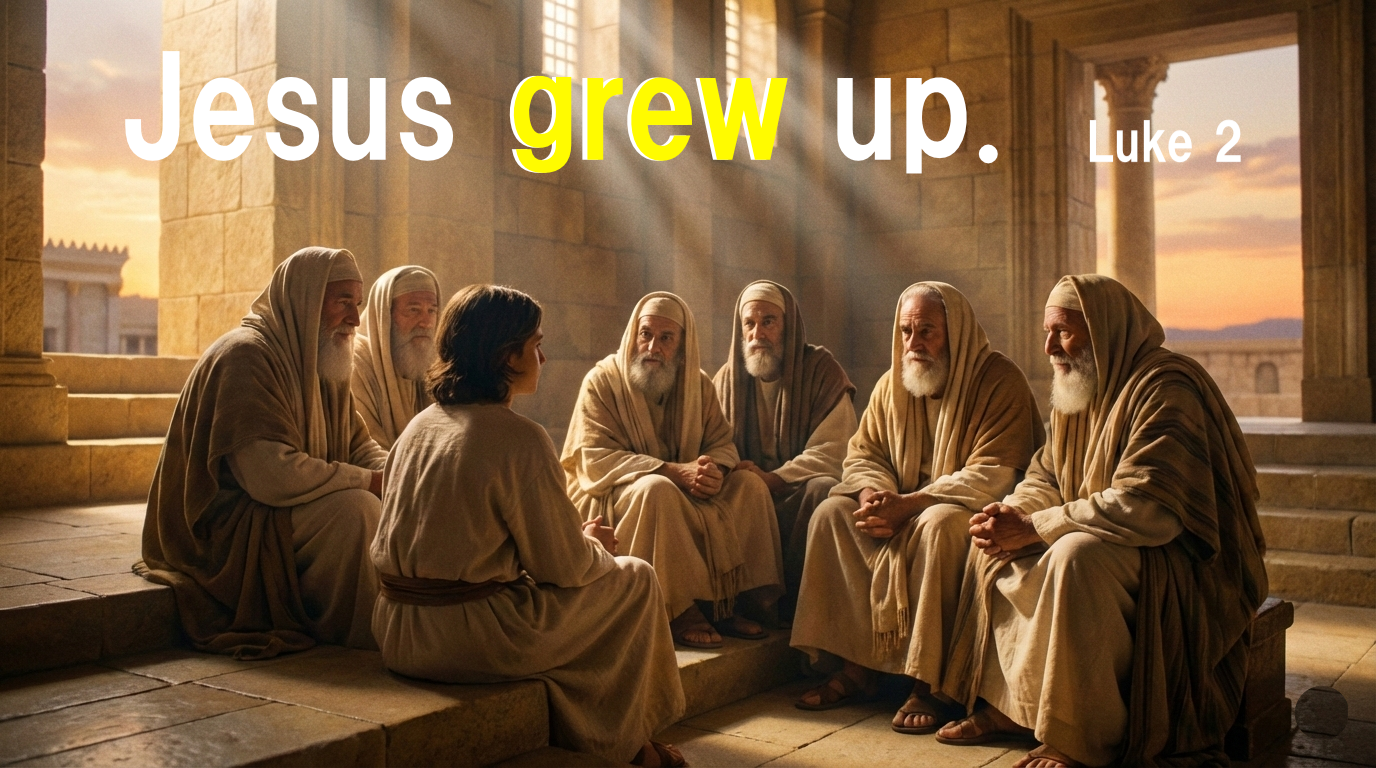
Worship Message No.17_December 28: Luke 2:21-52
[Introduction] “After” Christmas
December 25th has passed, and the city’s illuminations have changed to New Year’s decorations.
After the excitement of the festival departs, we return to “everyday life.” However, the Christmas story of the Bible does not end in the stable.
Presentation of the Text:
In today’s passage, the appearances of Jesus on His 8th day, 40th day, and at 12 years old are recorded.
Here, there are no extraordinary miracles (angels or stars), but rather “Jesus in everyday life” who keeps the Law, visits the temple, and lives with His family.
Presentation of the Theme:
Christmas (the birth) was not the goal, but the start. Today, from the figures of the people surrounding the child Jesus and the figure of the growing Jesus Himself, let us hear how we should receive “salvation” and head toward the New Year at this year-end.
[Luke 2:21-24] Theme: The Savior Placed Under the Law
Please look at verse 21. It says, “On the eighth day, when it was time to circumcise the child.”
For a newborn baby, this is the first “pain” experienced in life.
And it is the “blood” that is shed. Jesus, the Son of God, just eight days after being born, received circumcision—the sign of Israel’s covenant—and bore a wound in His own body.
Why?
Why did He, who is God, need to do such a thing?
Paul later said this:
“But when the set time had fully come, God sent his Son, born of a woman, born under the law, to redeem those under the law” (Galatians 4:4-5).
Jesus did not seek special treatment. He dared to descend to the same position as us humans, a position bound by the Law, and from this 8th day of life, He began His walk of bearing all our obligations and burdens.
[Point 1: His Name is “Jesus”]
And at this time, for the first time publicly, He was given the name “Jesus” (Hebrew “Yeshua יהושע” = The Lord is Salvation).
This is the name commanded by the angel Gabriel at the time of the Annunciation.
In this name, the mission to “save his people from their sins” is contained.
It is symbolic that on the day of circumcision, when the first blood was shed, this name “Savior” was declared.
This is because the life of Jesus is a path of thorough “humility and sacrifice” starting from the manger in Bethlehem and leading to the cross of Golgotha.
[Point 2: The Offering of a Poor Couple]
Furthermore, verses 22 to 24 record the appearance of the “Presentation in the Temple.”
What I would like you to notice here is what Mary and Joseph offered to God in the temple.
Please look at verse 24: “a pair of doves or two young pigeons.”
According to the regulations of Leviticus (Chapter 12), originally,
what should be offered in gratitude for a child’s birth was “a year-old lamb.”
However, if they did not have the financial means
(the Bible expresses it as “If she cannot afford a lamb”),
it was permitted as a special case to offer “two pigeons.”
What does this mean?
It means that the earthly home that raised Jesus was a poor home that could not even afford to offer a single lamb at the temple.
Here lies the amazing paradox of Christmas.
Jesus Himself is the true “Lamb,” whom John the Baptist later called “the Lamb of God, who takes away the sin of the world.” He is the King of the whole universe and the owner of all wealth. However, when that King came to the temple, His parents could not buy a lamb due to poverty and had no choice but to offer small pigeons.
[Application: Poverty for Our Sake]
Brothers and sisters. If Jesus had been born in a royal palace and offered the highest quality lamb in a temple decorated with gold,
we might have felt that “God is a distant existence” or “He is the God of rich or great people.”
However,
the Lord chose a home that could only make “an offering of pigeons.”
This was so that no one—the poor in this world or those made small—would be left out of His grace.
Within this short description from verses 21 to 24,
the image of “Jesus who entered under the Law for our sake and bore pain (circumcision)” and
“Jesus who became poor for our sake and descended to the lowly” is clearly engraved.
This thorough humility is exactly the figure of the Savior we believe in.
After this, Simeon and Anna appear, and what they were waiting for was to see through to such a “poor and humble Messiah.”
To find the Savior not in a magnificent procession but in a poor couple carrying pigeons, spiritual eyes were necessary.
[The Praise of Simeon and Anna (vv. 25-40)]
In the Temple of Jerusalem, there were two elderly people: Simeon and Anna.
They were not people of special power, but people who prayed in the temple day after day, waiting for salvation.
When they saw the small baby held by the poor couple (Mary and Joseph), they immediately saw through that He was the “Savior.”
Application and Reflection:
How did they know?
It was because they were with the Holy Spirit and “waiting” while believing in God’s promise.
We too need “eyes of faith” to find the presence of Christ not only in flashy miracles, but in mundane daily life, or in things that appear weak and small.
Simeon’s Song (vv. 29-32) “Nunc Dimittis”
The words “Sovereign Lord, as you have promised, you may now dismiss…” are called
“Nunc Dimittis” (Now let depart) in Latin.
What is important here is that salvation is declared as “a light for revelation to the Gentiles” (reflecting the “nations” (Hebrew Goyim גויים) in Isaiah 42:6, 49:6).
The theme of universal salvation (universalism) characteristic of Luke is emphasized.
Furthermore, Luke, who wrote this Gospel, later recorded in the “Acts of the Apostles” how this Gospel spread throughout the world.
Simeon’s Prophecy (vv. 34-35): At the same time, Simeon spoke that “a sword will pierce your own soul.”
Following Jesus involves not only joy but also the pain of one’s old heart being broken.
However, that very thing is the path to true salvation.
The Prophetess Anna (vv. 36-37)
At the moment the sound of Simeon’s song of praise echoed, another person approached.
It was the prophetess Anna.
The name Anna is the same as the Hebrew “Hannah,” meaning “Grace.”
Luke records her profile in great detail.
“the daughter of Penuel, of the tribe of Asher.”
The “tribe of Asher” is one of the ten tribes of Israel that were once lost.
A descendant of a tribe that seemed buried and forgotten in history was here, firmly remaining.
We can see even from this one line that God has by no means forgotten His people.
Point 1: Turning Loss into Devotion
Anna’s life might be called a “tragedy” if seen through human eyes.
She lost her husband only seven years after getting married.
In the society of that time, becoming a “widow” at a young age meant losing economic security and a weakening of social standing. It was deep loneliness and anxiety with nothing to rely on.
However, she did not turn that loneliness into “despair.”
She turned it into “total devotion to God.”
The Bible says: “She never left the temple but worshiped night and day, fasting and praying.”
During the long years of “being eighty-four (or having lived as a widow for 84 years),”
what was she doing? She was not sulking at the world.
In a corner of the temple, instead of lamenting her circumstances, day after day, she was interceding and praying for the redemption of Israel.
The temple was her place of living.
Remaining before God was her very purpose for living and her work.
Point 2: A Person of Prayer has Good “Eyes”
Everyone, please imagine.
Every day, hundreds or thousands of people enter and leave the temple.
Wealthy merchants, grand priests, and dressed-up pilgrims.
In that bustle, Anna fixed her eyes on a small baby held by a poorly dressed couple.
Why did Anna know?
Why could she notice that the child was the Savior?
It was because her eyes were “sharpened through prayer.”
To her, who had continued fellowship with God through fasting and prayer for decades, she intuitively understood what God was doing.
“Praying” is by no means a passive thing.
Prayer is the most active “work” for preparing for God’s salvation.
The accumulation of Anna’s continued prayer without leaving the temple became the power to find Christ at the decisive moment.
Not the glitz of the world, but spiritual eyes to see the truth were nurtured during her long life of “waiting.”
Simeon is a man. Anna is a woman.
It can also be read that Simeon was led by “the inspiration of the Lord,” while Anna was led by “fasting and prayer (discipline).”
These two are models of faith for the elderly. Their eyes saw through to the glory of God not in a flashy palace, but in the infant held by a poor couple.
Under the Law, a matter is established by “two witnesses.”
God set up two elderly people, a man and a woman, as witnesses to testify to Jesus’ legitimacy as the Savior.
Verse 38: It says she was not satisfied just by seeing, but
“spoke about the child to all who were looking forward to the redemption of Jerusalem.”
She can be called one of the first female missionaries (evangelists) in the Gospel of Luke.
This is an encouragement for the active faith of the elderly.
[The Case of the “Lost” Boy Jesus (vv. 41-50)]
Time passes, and Jesus becomes 12 years old.
After the Passover Festival, Jesus remained in the temple.
In Judaism, one becomes a “Bar Mitzvah (Son of the Law)” and joins the ranks of adults at age 13, so 12 is the period of preparation for that.
His words to His parents searching in worry: “Didn’t you know I had to be in my Father’s house?” (v. 49).
This is not a mere case of being a lost child. Nor are they words of a rebellious phase;
it was a declaration of Jesus’ identity: “Whose child am I? (the Son of God).”
For Jesus, the place of highest priority on this earth was the place of fellowship with God (the Father’s house).
Application and Reflection: In the busyness of the year-end, have we “lost sight of Jesus” like Joseph and Mary?
Are we leaving Jesus behind, our hearts captured by various errands?
Jesus is in “the Father’s house (worship, prayer, the Word).”
As we welcome the New Year, let us reset the priorities of our lives back to “the Father’s house.”
[Explanation of the Scripture (vv. 51-52)]
Mary’s Reaction: She could not completely understand her son’s words, but
“treasured all these things in her heart.”
As in verse 19, which we learned last time, the word here is “rhema.” She is storing it in her heart.
Even if an answer does not come immediately, it is an attitude of trust waiting for God’s time.
The Growth of Jesus: And Jesus returned to Nazareth and was obedient to His parents.
Verse 52 says: “And Jesus grew in wisdom and stature, and in favor with God and man.”
Even being the Son of God, He did not skip the human time process and walked the process of growth sincerely.
Application:
In the life of faith, there are “things we don’t understand” and “times of waiting.”
At those times, let us not try to produce an answer hastily, but like Mary, store the Word (rhema) in our hearts.
That accumulation will grow our spiritual stature.
[Conclusion] (Approx. 2 minutes)
Invitation to the New Year
The Christmas decorations have been put away, and the usual daily life has returned.
However, our journey of faith truly begins from here.
Today, we saw the figures of the elderly Simeon and Anna.
They found the light of the Savior not in a flashy palace, but in poverty and in weakness.
That was because they were “people who wait” and “people of prayer.”
Also, we saw the figure of the 12-year-old boy Jesus.
“I am in my Father’s house.” Just as those words say,
the Lord valued fellowship with God above all else and grew in wisdom and stature.
Now, as 2025 is about to end, let us quietly ask our own hearts.
Have we left Jesus behind in the busyness of this past year?
Did we have eyes to find the Lord’s presence in our daily lives?
Just as Mary “treasured” all things in her heart, let us now treasure the Word that has been spoken in our hearts.
And for the coming New Year,
let us join in prayer, desiring that we too may grow in Christ.
[Prayer]
(A prayer thanking for the grace of Christmas and asking for growth and devotion in the Lord toward the coming year)
Heavenly Father, God.
We hallow Your name and offer heartfelt praise.
We thank You for the humility of the Lord, who sent His Son into the world for our sake, took on the same flesh as us, and even descended under the Law.
The Lord lived in our midst as one who knows pain and as one who knows poverty.
Lord, we celebrated the events of Christmas,
but we are weak people who are immediately chased by the busyness of daily life after the festival and lose sight of Your presence.
Please, through today’s Word, open our spiritual eyes.
May we, like Simeon, find Your salvation in our daily lives.
May we, like Anna, turn even times of sadness or loneliness into a place of prayer.
Even when we cannot see an answer immediately, may we, like Mary, treasure Your Word in our hearts and wait, trusting in Your time.
And Lord, just as the boy Jesus loved “the Father’s house” above all else, may we also place worshiping You at the center of our lives in the coming new year.
Please bless each one of us, grow our stature of faith, increase our wisdom, and let us grow into those loved by God and man.
Thanking You for the grace that protected our walk through 2024, we head toward the New Year with expectation.
We pray in the name of our Savior, the Lord Jesus Christ.
Amen
コメント (手動承認)