Scripture Passage: Revelation 13:1–18
Introduction: Background and Context
Reflecting on the previous message. In Chapter 12, the “woman clothed with the sun” and the red dragon appeared.
The conclusion of Chapter 12 is that those who stand on God’s side will surely be targeted. However, they will surely be protected.
Revelation is a book written by John in the 90s AD, while he was exiled to the island of Patmos under the persecution of Emperor Domitian.
The saints of that time were forced to practice Emperor worship by the Roman Empire, facing economic exclusion, imprisonment, and death if they refused.
This book is not a “secret code,” but a pastoral letter to the church in the midst of suffering.
Sermon Body: Three Themes
Theme 1: The First Beast (v. 1–10) — The Temptation of Power
Theme 2: The Second Beast (v. 11–17) — The Forgery of Religion
Theme 3: The Mystery of 666 (v. 18) — A Call for Wisdom
Theme 1: The First Beast (v. 1–10) — The Temptation of Power
John describes a “beast coming out of the sea.” Ten horns, seven heads, a composite of a leopard, bear, and lion.
This is a unification of the four beasts from Daniel chapter 7.
Just as Daniel’s four beasts represented Babylon, Media, Persia, and Greece, this beast is “perfected evil power” symbolizing all world empires.
Note the expression in verse 3: “the fatal wound had been healed.”
This is a forgery of Christ’s death and resurrection. The dragon imitates what Christ does.
A false resurrection, a false authority—this is the essence of the Antichrist.
The world says, “Who is like the beast? Who can wage war against it?” (v. 4).
“Powers that do not acknowledge God always say, ‘Who can oppose me?’
The Roman Emperors said so. Modern totalitarians said so too.
However, verse 10 concludes as follows: ‘This calls for patient endurance and faithfulness on the part of God’s people.'”
“If anyone is to go into captivity, into captivity they will go. If anyone is to be killed with the sword, with the sword they shall be killed. This calls for patient endurance and faithfulness on the part of God’s people.” (13:10 NIV)
This is not a call to “retaliate.” It is a declaration of trust that “God is the Judge.”
Theme 2: The Second Beast (v. 11–17) — The Forgery of Religion
The second beast has “two horns like a lamb” (v. 11).
It looks religious and gentle, but it speaks “like a dragon.”
This is the essence of a false prophet.
In John’s time, the priesthood for Roman Emperor worship established in the province of Asia corresponded to this.
They performed signs, even making fire come down from heaven (v. 13), gave breath to the image of the emperor (v. 15), and economically excluded those who did not worship (v. 17).
Note that the second beast is the “promoter” for the first beast.
Power always requires a religious or ideological apparatus for justification.
Just as the Nazi regime utilized “German Christianity” and the former Soviet Union turned Communism into a pseudo-religion, the beast always demands worship.
“What are we worshiping? Economic prosperity? National identity? Or the Lamb of God?” the Bible asks.
Theme 3: The Mystery of 666 (v. 18) — A Call for Wisdom
“This calls for wisdom. Let the person who has insight calculate the number of the beast, for it is the number of a man. That number is 666.” (v. 18 NIV)
Understanding Gematria (Numerical Symbolism) In ancient Hebrew and Greek, numbers correspond to letters (gematria).
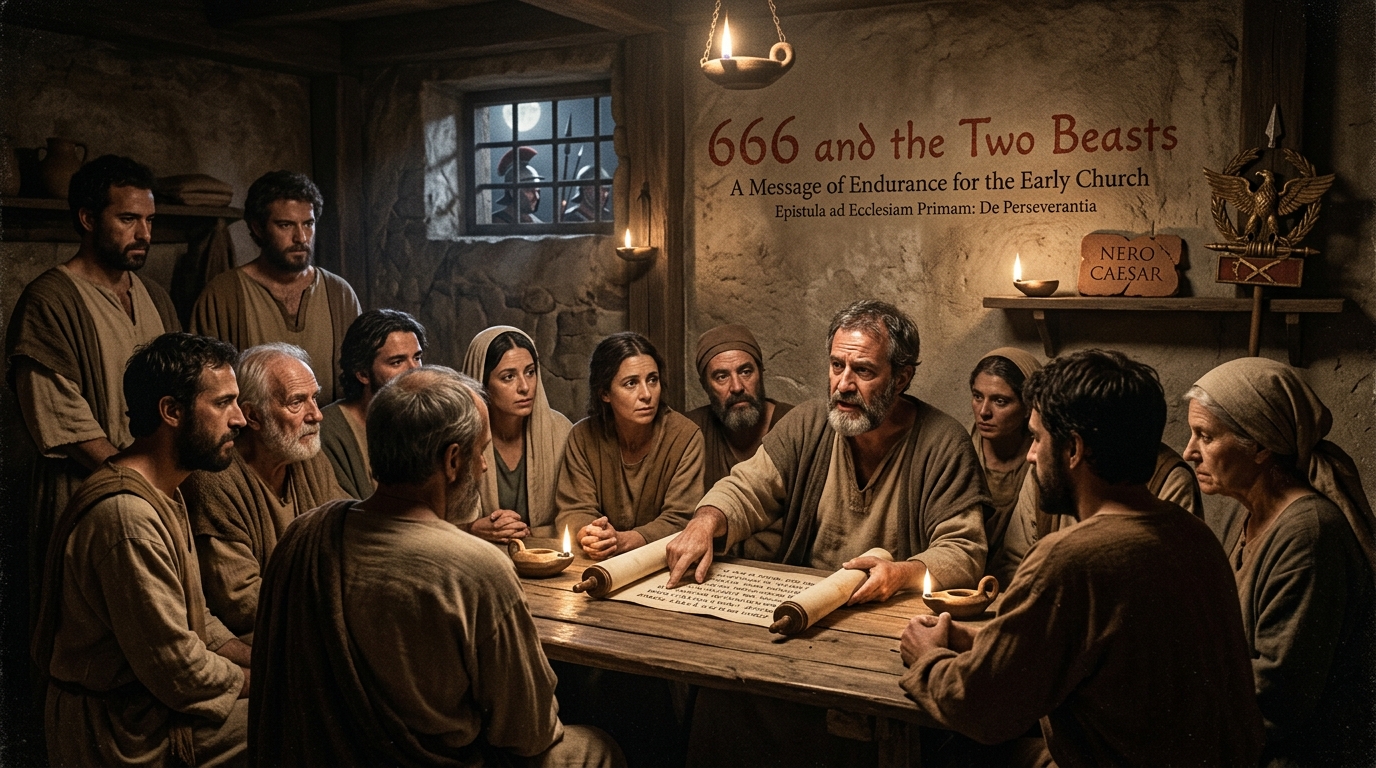
When “Nero Caesar” is written in Hebrew, the sum of the numerical values is 666.
This is the interpretation closest to the current academic consensus. However, since Emperor Nero had already passed away, the 666 here does not refer to him.
But what is important:
7 = God’s number of perfection
6 = Imperfect, human, failing to reach God
666 = Triple imperfection—meaning it looks like God but is not God.
No matter how mighty the power, no matter how skillfully it wears a religious guise, it is fundamentally lacking before God.
John is telling this to the congregation.
Conclusion: What is the “Endurance of the Saints”?
What Revelation 13 asks most sharply is the “conflict of worship.”
In Chapter 14, verse 1 (the text immediately following), 144,000 stand with the Lamb, and it is written that they have “his name and his Father’s name written on their foreheads.”
In contrast to the mark of 666, the name of God is engraved on their foreheads.
“What are you living according to; are you choosing for yourself?”
Whether in politics, economy, TV, or SNS, stopping your own thinking because
“everyone else says so” or
“it’s a loss to resist” is actually the most dangerous thing.
Whose side are you on? To whom do you belong!? That is the core of Revelation.
John wrote to the churches in Asia Minor under persecution. This chapter is not a book of terror. It is a book of endurance.
Chapter 13 depicts the “end of those who follow the beast” because he “wants them to realize.”
But actually, in the next chapter, Chapter 14, a completely different story begins.
Where do those who rejected the mark of the beast head?
In Chapter 14, the mysterious number “144,000” appears, and the dark flow of Chapter 13 is reversed all at once. The answer to the question “How can I be saved in the end?” is written right there.
Next time, we will cover Revelation Chapter 14.
Prayer
Amen

コメント (手動承認)